30th Jul 2026
A well-chosen set of boat fenders can prevent scratches, chipped gelcoat, damaged paintwork and more serious impact damage when your boat is alongside a pontoon, quay or another vessel.
Although there are many types of marine fenders available, cylindrical boat fenders remain the most widely used option for everyday mooring. They are simple, versatile, easy to reposition and available in sizes suitable for everything from small day boats to large yachts and commercial craft. However, choosing the best boat fenders involves more than matching their colour to your hull. Fender diameter, length, construction, inflation pressure, hanging height and quantity all influence how much protection they provide.
This comprehensive boat fender guide explains how cylindrical fenders work, how to select the correct fender sizes, how many boat fenders you need and how to position them for different mooring situations. It also covers inflation, cleaning, storage, replacement and the accessories needed to create a reliable fendering system.
Quick definition:
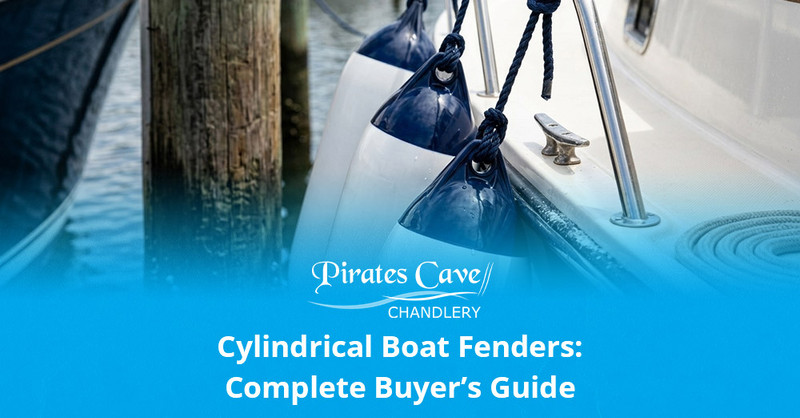
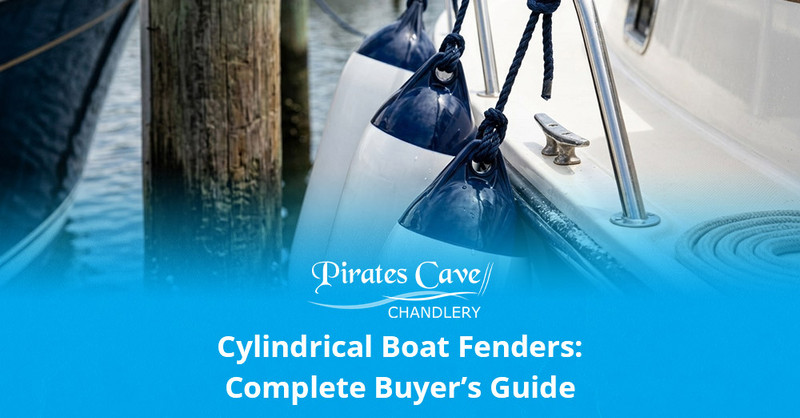
Cylindrical boat fenders are long, inflatable or solid protective buffers positioned between a boat and a pontoon, quay, lock wall or neighbouring vessel. Their job is to compress under pressure, absorb impact energy and maintain a safe gap between the two surfaces.
What Are Cylindrical Boat Fenders?
Cylindrical boat fenders are elongated protective cushions, usually manufactured from flexible marine-grade PVC or a similar durable plastic. Most are filled with air and feature either reinforced rope eyes at one or both ends or a central tube through which a fender rope can be passed.
You may also hear them described as:
- Sausage fenders.
- Tube fenders.
- Inflatable boat fenders.
- Yacht fenders.
- Side fenders.
- Mooring fenders.
- Ribbed boat fenders.
- Through-line or centre-hole fenders.
Their shape allows them to be hung vertically against the side of a boat or horizontally across a wider contact area. This makes them suitable for many different hull forms and mooring arrangements.
Most cylindrical fenders have three main measurements:
- Diameter: The width of the fender when correctly inflated.
- Length: The overall length of its protective body.
- Eye or rope-hole size: The opening through which the fender line is attached.
Diameter is particularly important. It determines the stand-off distance between the hull and the surface beside it. A fender that is too narrow may compress fully, allowing the boat to touch the pontoon or neighbouring vessel. Fenders protect a boat by compressing under load and slowing the impact rather than allowing two hard surfaces to meet abruptly. A larger-diameter fender generally provides more contact area and greater energy absorption before it becomes fully compressed.
Why Are Cylindrical Fenders So Popular?
Cylindrical boat fenders are popular because they provide a practical balance between protection, storage space, versatility and cost. They work in many different situations
A set of cylindrical fenders can be used when:
- Mooring alongside a floating pontoon.
- Entering marina berths.
- Passing through locks.
- Rafting alongside another boat.
- Tying up against a quay.
- Protecting a boat at a tidal mooring.
- Temporarily lying alongside a fuel berth.
- Mooring a narrowboat against a canal bank.
- Protecting a yacht or motorboat from neighbouring vessels.
They can be moved quickly as conditions change, making them useful for boat owners who visit different harbours and mooring environments.
They are easy to position: A cylindrical fender can normally be raised or lowered using a single fender rope. Models with eyes at both ends can also be hung horizontally, while through-line designs allow the rope position to be adjusted along the full length of the fender.
They are relatively easy to store: Compared with large Round Fenders, cylindrical models occupy less locker or deck space. Their straight shape also makes them easier to arrange in fender baskets.
They are available in a wide range of sizes: Small cylindrical fenders can protect dinghies, day boats and RIBs. Larger heavy duty boat fenders can be used on substantial motor cruisers, sailing yachts, workboats and commercial vessels.
They offer good value: Quality fenders are considerably less expensive than repairing damaged gelcoat, repainting a hull or replacing damaged rubbing strakes. Carrying an extra fender is often a sensible precaution, particularly in exposed or unfamiliar berths.
How Do Boat Fenders Protect Your Vessel?
Boat fenders act as shock absorbers. When a boat moves towards a pontoon, quay or another vessel, the fender is compressed between the two surfaces. The flexible wall and the air inside it resist that compression, slowing the movement and spreading the load across a larger area.
This performs three important functions.
1. Absorbing impact
A correctly sized fender reduces the force transmitted to the hull during a minor collision or an imperfect approach.
2. Preventing abrasion
Boats rarely remain completely still after they have been secured. Wind, tide, current, wash and crew movement can cause the hull to surge or rub against the berth.
The fender keeps the hull away from rough concrete, timber, metal fittings and neighbouring boats.
3. Maintaining stand-off
“Stand-off” means the gap created between the boat and the object beside it. A larger fender diameter normally creates greater stand-off, although hull shape and positioning must also be considered.
A fender cannot provide complete protection if it is too small, incorrectly positioned or able to roll away from the contact point.
What Are Cylindrical Boat Fenders Made From?
Most inflatable cylindrical boat fenders are made from flexible marine-grade PVC or another moulded plastic formulation designed for repeated compression.
Marine-grade PVC:
PVC boat fenders are popular because PVC can be manufactured to provide a useful combination of:
- Flexibility.
- Impact resistance.
- Abrasion resistance.
- Weather resistance.
- Mouldability.
- Colour consistency.
- Reasonable weight.
Not all PVC fenders are constructed to the same standard. Wall thickness, moulding process, UV stabilisation, seam construction and rope-eye reinforcement all influence durability.
Rotationally moulded plastics:
Some heavy-duty fenders are rotationally moulded. During this process, plastic material is distributed around the inside of a rotating mould. The aim is to produce a one-piece body with a consistent wall thickness and fewer structurally weak areas.
Reinforced rope eyes:
The rope eye carries the load transferred through the fender line. Better-quality models may feature:
- Thicker moulded ends.
- Solid or reinforced rope eyes.
- Integrated bushes.
- Stronger end sections.
- Additional material around the eye.
- A tube running through the entire fender.
The rope should be appropriately sized for the eye. A line that is too thin can concentrate the load onto a small area and may cut into or damage a soft plastic rope hold. Polyform recommends using the largest practical line diameter for the fender eye rather than an unnecessarily thin rope.
Inflation valves
Inflatable boat fenders normally use one of several valve designs:
- Needle valves similar to those used on sports equipment.
- Screw-in valves.
- Plug-style valves.
- Valves designed for a tapered inflation adaptor.
- Replaceable brass or plastic valves.
The correct pump attachment depends on the manufacturer. Never force an unsuitable needle or metal fitting into a valve, as this can damage the seal.
Solid foam constructions:
Not every marine fender is inflatable. Some specialist bow, stern and pontoon fenders use solid foam or a flexible foam core. Solid fenders cannot lose air, but they are often less adjustable and may be more expensive or more difficult to store. They are generally selected for a specific position rather than used as general-purpose side fenders.
Ribbed vs Smooth Cylindrical Fenders
Both ribbed and smooth cylindrical fenders can provide effective protection. The best choice depends on the hull finish, mooring environment, product construction and personal preference.
| Feature | Ribbed boat fenders | Smooth boat fenders |
| Surface | Raised vertical or horizontal ribs | Flat or lightly textured surface |
| Abrasion contact | Contact may be distributed across the ribs | Broad, continuous contact area |
| Rolling movement | Ribs may help limit some movement | May roll more freely against smooth surfaces |
| Cleaning | Dirt can collect between ribs | Usually quicker to wipe clean |
| Appearance | Traditional, practical appearance | Cleaner, more streamlined appearance |
| Typical use | General marina and working-boat use | Yachts, cruisers and general mooring |
Advantages of ribbed boat fenders
Ribs can add structure to the body and provide multiple contact points against a hull or pontoon. Some through-line and heavy-duty designs use vertical ribs alongside thicker walls and reinforced tube ends. Ribbed fenders are particularly common where a robust, functional appearance is preferred.
Advantages of smooth fenders
Smooth fenders are easy to wipe down and may be less likely to trap grit between raised sections. They can also suit owners looking for an uncluttered appearance alongside polished topsides.
Which is better?
Neither surface is automatically superior. Overall construction quality, size, positioning and maintenance matter more than whether the body is ribbed or smooth. A poorly positioned premium fender will provide less protection than a correctly positioned, suitably sized standard model.
Heavy-Duty vs Standard Cylindrical Fenders
The term “heavy duty” can mean different things between manufacturers. It does not refer to one universal specification.
A heavy-duty model may have:
Greater wall thickness
Larger overall dimensions
Reinforced or solid rope eyes
Stronger through-tubes
A more robust inflation valve
One-piece or rotationally moulded construction
Greater resistance to punctures and tearing
Construction intended for repeated or commercial use
| Consideration | Standard cylindrical fender | Heavy-duty cylindrical fender |
| Typical use | Sheltered marinas and normal leisure use | Exposed berths, working boats and frequent use |
| Weight | Usually lighter | Usually heavier |
| Wall construction | Standard flexible wall | Often thicker or reinforced |
| Rope eye | Conventional moulded eye | May have a solid or reinforced eye |
| Storage | Easier to handle and stow | Requires more storage space |
| Cost | Generally lower | Generally higher |
| Impact capacity | Appropriate when correctly sized | Greater reserve for demanding conditions |
When is a standard fender sufficient?
A good-quality standard fender is usually suitable when:
- The boat is kept in a sheltered marina.
- The pontoon moves with the water level.
- The boat is used recreationally.
- There is limited exposure to wash or surge.
- The fenders can be checked regularly.
- The correct size and quantity are used.
When should you consider heavy duty boat fenders?
Heavy-duty models are worth considering when:
- Your berth is exposed to wind, chop or passing traffic.
- Your boat is particularly heavy for its length.
- You regularly use rough quay walls.
- You raft alongside larger vessels.
- The fenders will be used commercially.
- You require a through-line construction.
- The boat remains moored for extended periods.
- There is a risk of a fender becoming trapped or heavily compressed.
The name on the label is less important than the actual construction. Compare dimensions, body design, rope-eye reinforcement and manufacturer guidance.
How to Choose the Correct Fender Size
Choosing the right size is one of the most important parts of buying cylindrical boat fenders. A fender that is too small may look neat but compress completely under load. A model that is unnecessarily large may be awkward to handle, difficult to store and unsuitable for your boat’s freeboard.
Start with diameter, not just length.
Diameter determines how much separation exists between the hull and the berth. Length determines how much vertical area the fender can protect and how tolerant the setup is of changing water level or inaccurate positioning. Both measurements matter, but diameter is normally the first figure to consider.
Cylindrical fender size chart
The following table is a practical starting point rather than a fixed specification. Boat weight, hull shape, freeboard and local conditions may require a larger size.
| Approximate boat length | Starting cylindrical fender diameter | Suggested minimum quantity |
| Under 3 metres / 10 feet | 7-8cm | 3 |
| 3–4.5 metres / 10–15 feet | 8-10cm | 3 |
| 4.5–6 metres / 15–20 feet | 12-14cm | 3-4 |
| 6–7.5 metres / 20–25 feet | 15-17cm | 4 |
| 7.5–10.5 metres / 25–35 feet | 20-22cm | 4-5 |
| 10.5–15 metres / 35–50 feet | 27-30cm | 5-6 |
| 15 metres / 50 feet and above | 30cm or larger | 6 or more |
A commonly used rule of thumb is approximately one inch of cylindrical fender diameter for every four to five feet of boat length. This should be treated as a minimum starting point rather than a guarantee of suitability.
Factors that may require a larger fender
Choose the next size up when the boat is:
- Heavy for its overall length.
- Kept at an exposed berth.
- Moored against fixed quay walls.
- Regularly affected by tidal surge.
- Used in busy marinas.
- Rafted alongside other boats.
- High-sided or unusually shaped.
- Used commercially.
- Frequently handled by an inexperienced crew.
- Likely to encounter rough timber, masonry or metalwork.
Manufacturers describe their fender size tables as general guides because local conditions and vessel design can significantly affect the protection required.
Consider your boat’s freeboard
Freeboard is the vertical distance between the waterline and the deck or upper edge of the hull. A low-freeboard sports boat may need a shorter fender positioned close to the water. A high-sided motor cruiser may need a longer fender or multiple fenders at different heights.
Consider the pontoon or quay height
A fender must cover the actual point of contact. A large fender can still fail to protect the boat if it is positioned above or below the pontoon edge. Consider the relationship between:
- Waterline.
- Rubbing strake.
- Maximum beam.
- Pontoon edge.
- Tidal range.
- Fender length.
How Many Boat Fenders Do I Need?
For most leisure boats, use at least three fenders on the side approaching the berth.
A widely used starting formula is:
One fender for every 10 feet of boat length, plus one additional fender.
Using this formula:
| Boat Length | Suggested starting quantity |
| Up to 20 feet | 3 fenders |
| 20-30 feet | 4 fenders |
| 30-40 feet | 5 fenders |
| 40-50 feet | 6 fenders |
| 50-60 feet | 7 fenders |
The calculation is only a starting point. we recommend adding more fenders for exposed docks, tidal surge or rough conditions, while Polyform advises using at least three when docking.
Carry at least one spare
A spare fender can be used when:
- A neighbouring boat has insufficient protection.
- A berth contains an unexpected obstruction.
- The wind changes.
- A fender line is lost.
- One fender becomes punctured.
- Extra protection is needed at the bow or stern.
- You enter a lock or fuel berth.
- You raft alongside a differently shaped boat.
The fenders deployed for a straightforward marina approach may not be enough for every situation encountered during a trip.
More fenders do not compensate for the wrong size
Six undersized fenders are not necessarily better than four correctly sized models. If each fender compresses completely, the hull can still reach the pontoon. Use the correct diameter first, then increase the number to cover vulnerable areas.
How to Hang Boat Fenders Correctly
The basic objective is simple: Position each fender at the height and location where the boat is most likely to touch the pontoon, quay or neighbouring vessel.
Use secure attachment points:
Suitable attachment points may include:
- Deck cleats.
- Dedicated fender eyes.
- Strong toe-rail fittings.
- The reinforced base of a stanchion.
- Substantial rails designed to carry the load.
Avoid fixing a heavily loaded fender to a weak guard wire, lightweight handrail or fitting that is not securely attached to the deck or hull. Polyform recommends attachment to a cleat or the base of a stanchion rather than relying on an upper rail that may not be designed for the load.
Position fenders before the final approach
Do not wait until the boat is already touching the pontoon. Prepare the fenders, lines and crew before entering the berth. Confirm which side will be alongside and deploy the fenders on that side. Keep a spare ready for an unexpected contact point.
Protect three main areas
For an ordinary alongside berth, begin with:
- One fender towards the bow.
- One or two near maximum beam.
- One fender towards the stern.
Maximum beam is the widest part of the boat and often the area that remains in contact once the boat is secured.
Set the correct height
The fender should overlap the pontoon edge or contact area rather than floating below it or hanging above it. As a general guide, position it so the lower portion extends beneath the contact edge. Recheck the height once the boat is tied up because the hull may settle differently after the mooring lines are tensioned.
Our attachment guide recommends placing at least three along the docking side and adjusting them so the lower part meets the dock or neighbouring hull.
Vertical vs horizontal hanging:
Hang fenders vertically when:
- Mooring beside a floating pontoon.
- The contact point is relatively narrow.
- You need quick height adjustment.
- The boat and pontoon rise together.
- Using conventional single-eye cylindrical fenders.
Hang fenders horizontally when:
- Protecting against posts or pilings.
- Covering a long horizontal contact area.
- Rafting against a boat with different freeboard.
- Working alongside a rough quay.
- Managing significant water-level changes.
- Using a through-line or twin-eye fender.
To hang a fender horizontally, secure both ends and spread the load across two attachment points.
Keep the fender line short enough
An excessively long line allows the fender to swing, float away or be squeezed out from between the hull and pontoon. The fender should have enough movement to settle naturally, but not so much that it escapes the contact area.
Correct Fender Positioning for Different Boats
Different hull shapes require different arrangements. There is no single fender plan that works for every vessel.
Sailing yachts
Sailing yachts commonly have curved topsides and their widest point may be near the centre of the hull.
Place:
- One fender forward of maximum beam.
- One at maximum beam.
- One aft of maximum beam.
- Additional protection near the stern quarter where required.
Do not assume a fender hanging from the guardrail will naturally settle at the right height. Check where its body actually contacts the hull.
Motorboats and motor cruisers
Motorboats often have higher topsides, broader stern quarters and more complex hull mouldings. They may benefit from:
- Longer cylindrical yacht fenders.
- Two fenders around the widest central section.
- An extra fender at the aft quarter.
- A specialist Stern Fender for stern-to berthing.
- Different fender heights at the bow and stern.
Take care not to position a fender against a window, vent, trim tab or delicate hull fitting.
RIBs and inflatable boats
The inflatable tube already provides some cushioning, but it can still suffer abrasion, staining or damage from rough pontoons and metal fittings.
Use appropriately sized fenders to keep the tube away from:
- Sharp pontoon corners.
- Exposed bolts.
- Rough timber.
- Barnacles.
- Other boats’ fittings.
Avoid creating excessive point pressure against an inflatable tube.
Narrowboats and canal boats
Cylindrical fenders can protect the sides of a narrowboat when moored, but traditional rope or purpose-shaped canal fenders are often used at the bow and stern. Side fenders should be positioned carefully around locks. The Canal & River Trust advises raising side fenders in narrow locks and warns that fenders can become caught on the lockside or gates.
For narrowboats:
- Use side fenders when moored.
- Raise or manage them when entering confined locks.
- Check that no fender can catch on ladders, gates or masonry.
- Use suitable bow and stern protection.
- Replace heavily worn rope fenders before their core becomes exposed.
- Specialist Bow Fenders and stern or narrowboat fenders may be more appropriate than cylindrical models at the ends of the vessel.
High-sided boats
High-sided motor yachts, workboats and barges may require:
- Longer cylindrical fenders.
- Two vertical rows at different heights.
- Large-diameter heavy-duty fenders.
- Horizontal through-line fenders.
- Fender boards against pilings.
The contact point may change significantly as the boat rolls or the tide changes.
Boats rafting alongside
When two boats are tied alongside one another, place the fenders at the points where their hulls will actually meet. Ideally, the boat already moored should have its fenders prepared before the second boat comes alongside. Polyform’s rafting guidance recommends concentrating standard fenders near maximum beam and adding round fenders fore and aft where greater separation is needed.
Consider:
- Differences in freeboard.
- Rigging and guardrail positions.
- Beam.
- Hull flare.
- Mast movement.
- Wash from passing vessels.
- Whether the boats will roll at different rates.
How to Inflate Boat Fenders
A fender must be correctly inflated to work as designed. Underinflation can reduce stand-off and allow the body to fold or collapse. Overinflation can make the fender unnecessarily hard, reduce its ability to absorb energy and place additional stress on the valve and seams.
What you will need
Depending on the valve, you may need:
- A hand pump.
- A bicycle-style pump.
- A low-pressure compressor.
- A manufacturer-specific adaptor.
- A pump needle.
- A tapered nozzle.
- A pressure gauge.
We supply pumps, needles and adaptors within our Fender Accessories range.
Step-by-step inflation process
- Identify the valve type.
Check the manufacturer’s instructions before inserting an adaptor. - Inspect the valve.
Remove dirt, salt or sand that could prevent the valve from sealing. - Attach the correct adaptor.
Do not force an oversized nozzle into the opening. - Inflate gradually.
Stop regularly to check the shape and firmness.# - Check the dimensions.
Some manufacturers provide a target diameter or circumference. - Confirm that the fender still compresses slightly.
It should feel firm but not rigid. - Replace the valve cap or plug.
Make sure it is correctly seated.
What pressure should boat fenders be?
Always follow the instructions for the specific brand and model.
For reference, Polyform specifies approximately 2.1psi or 0.15 bar for its inflatable fenders, while some other cylindrical fenders specify 2psi. These figures should not be applied automatically to every manufacturer.
Signs of overinflation:
- The fender feels extremely hard.
- The body appears stretched.
- The seams or ends look distorted.
- The published diameter is exceeded.
- The fender barely compresses under hand pressure.
Signs of underinflation:
- The fender folds under light pressure.
- It has deep wrinkles.
- The body does not hold its intended shape.
- The diameter is noticeably below specification.
- It collapses between the boat and pontoon.
Check pressure periodically because temperature changes can affect the air inside the fender.
Cleaning and Maintaining Cylindrical Fenders
Regular cleaning improves appearance and reduces the risk of trapped grit marking the hull.
Routine cleaning
For normal dirt and salt deposits:
- Rinse the fender with fresh water.
- Wash it using warm water and mild soap.
- Use a soft cloth, sponge or non-abrasive brush.
- Clean between ribs and around the rope eyes.
- Rinse thoroughly.
- Allow it to dry before storage.
Polyform’s published maintenance material demonstrates cleaning fenders with soap and water.
Removing stubborn marks
Marine grime, rubber transfer and algae may require a dedicated fender cleaner.
Before using any chemical:
- Check that it is suitable for PVC or the relevant material.
- Test it on an inconspicuous area.
- Follow the manufacturer’s dilution instructions.
- Avoid abrasive pads.
- Prevent chemical run-off into the water.
- Rinse the surface thoroughly.
Strong solvents may soften, stain or damage flexible plastics.
Inspect the fender during cleaning
Look for:
- Cuts.
- Deep abrasions.
- Cracks.
- Valve leakage.
- Distorted rope eyes.
- Faded or brittle plastic.
- Permanent flattening.
- Loose caps or plugs.
- Damage caused by unsuitable ropes.
Cleaning is an ideal time to identify a problem before the fender is needed.
Clean the fender lines too
Salt and grit can stiffen fender ropes and increase abrasion.
Rinse the lines in fresh water, inspect the splices and check for:
- Fraying.
- Glazing.
- Flattened sections.
- UV damage.
- Loose stitching.
- Damaged eye splices.
Replace questionable lines rather than risking the loss of a fender.
How to Store Boat Fenders
Correct storage protects fenders from unnecessary UV exposure, heat, contamination and physical damage.
Suitable storage locations
Depending on the boat, cylindrical fenders can be kept in:
- A ventilated cockpit locker.
- A dedicated fender locker.
- Stainless steel fender baskets.
- Rail-mounted holders.
- A clean equipment bag.
- A dry shoreside storage area.
Fender baskets are particularly useful because they keep fenders accessible without filling a cockpit locker. We offer baskets in several diameters to suit different cylindrical fender sizes.
Storage best practices
- Rinse away salt before long-term storage.
- Allow fenders and ropes to dry.
- Keep them away from fuel, oil and solvents.
- Avoid prolonged contact with sharp fittings.
- Do not stack heavy equipment on top of them.
- Keep them away from excessive heat.
- Reduce unnecessary exposure to direct sunlight.
- Check inflation before the next trip.
Polyform advise storing its fenders in a safe place away from direct sunlight.
Should boat fenders be deflated for storage?
Usually, no. Most owners store cylindrical fenders inflated and ready for use.
Partial deflation may be helpful when:
- Storage space is extremely limited.
- The manufacturer permits deflation.
- The correct adaptor is available for reinflation.
- The fender will be stored for a long period.
Repeatedly removing or forcing a valve can create unnecessary wear. Follow the instructions for the individual product.
Bring fenders aboard when underway
Unless they are required for immediate manoeuvring, retrieve and secure the fenders after leaving the berth.
Fenders left hanging can:
- Strike and mark the hull.
- Be lost.
- Become damaged.
- Catch on structures.
- Create unnecessary drag.
- Reach the propeller or steering gear in extreme cases.
Common Boat Fender Mistakes
Even experienced boat owners occasionally make preventable fendering mistakes.
Buying fenders that are too small
Small fenders are easier to store and may look less intrusive, but they provide less stand-off and can compress completely. When deciding between two suitable sizes, the larger option is generally safer where storage and handling allow.
Using too few fenders
Three fenders may be enough for a calm, straightforward berth, but they may not cover an irregular quay, exposed pontoon or rafting situation. Carry at least one spare.
Hanging them at the wrong height
A fender above the pontoon protects nothing. A fender floating horizontally on the water may also fail to cover the contact area. Adjust the height for the specific berth rather than leaving every fender permanently tied at one level.
Positioning every fender evenly
Equal spacing looks tidy but does not necessarily protect the most vulnerable areas.
Concentrate protection around:
- Maximum beam.
- Bow and stern quarters.
- Pontoon corners.
- Piles.
- Fittings.
- Hull sections likely to touch first.
Tying fenders to weak fittings
A fender can carry substantial loads when trapped between a moving boat and a fixed structure. Use strong attachment points rather than decorative rails or unsupported guard wires.
Using lines that are too thin
A thin line places concentrated pressure on the fender eye and can contribute to premature damage. Choose a diameter that fills a reasonable proportion of the eye without becoming difficult to tie.
Overinflating the fender
A rock-hard fender cannot compress as progressively as intended. Overinflation can also stress the valve and body.
Leaving grit trapped between the fender and hull
A dirty fender can act like an abrasive pad against polished gelcoat. Clean both the fender and hull contact area.
Relying on permanent dock fenders alone
Fixed dock fenders protect a home berth, but they do not help when visiting another marina. Carry boat-mounted fenders even when your regular pontoon is already padded.
Leaving side fenders deployed in confined locks
Fenders can become trapped against masonry, ladders or lock fittings. This is particularly important for narrowboats and canal craft. Raise or reposition them as the lock environment requires.
Cylindrical vs Round Fenders
Round fenders, also called ball or buoy fenders, create greater stand-off for their overall length and are useful where concentrated protection is needed.
| Feature | Cylindrical fenders | Round fenders |
| Shape | Long and narrow | Spherical or pear-shaped |
| Storage | Easier to store | Bulkier |
| General side protection | Excellent | Good, but covers a shorter hull length |
| Stand-off | Moderate to high | High |
| Rafting | Very useful | Excellent at bow and stern |
| Rough walls | Useful with correct positioning | Strong concentrated protection |
| Vertical adjustment | Easy | Easy but physically bulkier |
| Horizontal hanging | Possible on suitable models | Uncommon |
| Best for | Everyday marina and pontoon use | Corners, rafting and difficult contact points |
Choose cylindrical fenders when:
- You need an everyday set of yacht fenders.
- Storage space is limited.
- You usually moor alongside floating pontoons.
- You want easy vertical adjustment.
- You need protection along a longer section of hull.
Choose round fenders when:
- You need greater stand-off.
- Rafting is common.
- The bow or stern quarter needs extra protection.
- The berth has awkward corners.
- The boat has pronounced hull flare.
- You need a fender that can help around a pivot point.
Many well-prepared boats carry cylindrical fenders as their primary set and one or two round fenders for more demanding situations. Polyform notes that buoy-shaped fenders can provide greater stand-off than cylindrical models.
Best Uses for Cylindrical Boat Fenders
Floating marina pontoons
This is the most common use. Position the fenders vertically so they overlap the pontoon edge. Because the pontoon rises and falls with the boat, the contact height normally remains relatively consistent.
Fixed quays
A fixed quay does not move with the tide. Longer fenders, horizontal fenders or multiple heights may be needed as the water level changes. Inspect the quay for protruding bolts, ladders, timbers and masonry edges before relying on the fender position.
Tidal moorings
At a tidal berth, the angle of the mooring lines and the contact point may change throughout the tide.
Use:
- Larger-diameter fenders.
- Longer fenders.
- Secure fender lines.
- Additional high or low protection.
- Through-line fenders where horizontal deployment helps.
Recheck the arrangement after the tide has changed.
Locks
Cylindrical mooring fenders can cushion minor contact, but they must not be allowed to catch on the lockside, gates or ladders. Keep the boat under control with lines rather than expecting fenders to hold it in position.
Rafting
Position fenders between the widest areas of the two hulls. Add round fenders towards the bow and stern if the boats have different shapes or move independently.
Alongside pilings
A single cylindrical fender can roll away from a narrow piling.
Consider:
- A through-line fender hung horizontally.
- Multiple fenders.
- A fender board spanning two pilings.
- Fixed dock protection.
A fender board spreads the load and prevents individual fenders from being pushed between widely spaced posts.
Fuel and service berths
Temporary berths often have unfamiliar heights, hard corners and heavy traffic. Prepare the fenders before approaching and keep a spare ready.
Essential Fender Accessories
The fender is only one part of the system. Correct lines, fixings, storage and maintenance products improve both convenience and reliability.
Fender ropes and fender lines
Good Fender Lines should be:
- Comfortable to handle.
- Resistant to marine conditions.
- Suitable for the size of the fender eye.
- Long enough for the intended attachment point.
- Easy to adjust.
- Strong enough for the expected load.
Pre-spliced lines are convenient because the loop can be passed directly through or around the rope eye. We offer three-strand and double-braid polyester fender ropes in different diameters and colours.
Fender clips and hooks
Fender clips and hooks allow the height to be adjusted without repeatedly tying knots.
They are useful for:
- Rail-mounted fenders.
- Boats that visit different pontoon heights.
- Short-handed crews.
- Rapid deployment.
- Keeping preset line lengths.
Check that the hook fits the rail diameter and that both the hook and rail can carry the expected load.
Fender covers
Fender covers, also called fender socks, can:
- Improve appearance.
- Reduce squeaking.
- Limit direct rubbing against polished topsides.
- Help keep the fender surface cleaner.
However, a dirty cover can hold salt and grit against the hull. Remove and wash covers regularly, and inspect the fender beneath them.
Fender baskets
Rail-mounted baskets keep cylindrical fenders accessible and organised. Measure the inflated fender diameter before choosing a basket. It should hold the fender securely without gripping it so tightly that deployment becomes difficult.
Inflation equipment
Keep the correct pump and adaptor aboard. An inflation kit is inexpensive and avoids discovering that your fender has softened when no suitable adaptor is available.
Cleaning products
Use fender cleaners specifically described as suitable for flexible PVC, marine plastics or fender materials. Avoid untested household solvents.
Signs It Is Time to Replace Your Fenders
A fender does not need to burst completely before it becomes unreliable.
Consider replacement when you find:
- Deep cuts extending into the wall.
- Cracks around the valve.
- Air loss that continues after valve checks.
- Splitting or distortion around the rope eye.
- A brittle or hardened body.
- Permanent flattening.
- Severe UV degradation.
- A damaged through-tube.
- Repeated valve failure.
- Repairs that cannot be inspected confidently.
- Significant reduction in diameter.
- A fender that no longer rebounds after compression.
Surface scuffs and discolouration are often cosmetic. Structural cuts, valve leakage and damaged attachment points are more serious. Do not use a visibly weakened fender as the primary protection for a heavy boat in exposed conditions.
Cylindrical Boat Fender Buying Checklist
Before placing an order, confirm the following:
- What is the boat’s overall length?
- How heavy is the boat?
- What is the hull’s maximum beam?
- How high is the freeboard?
- Where is the boat normally moored?
- Is the berth sheltered, tidal or exposed?
- Will the fenders be used in locks?
- Do you regularly raft alongside other vessels?
- What is the height of the usual pontoon?
- Is vertical or horizontal hanging required?
- Are reinforced rope eyes needed?
- Would a through-line design be more suitable?
- How many fenders can be stored aboard?
- Do you already have compatible fender ropes?
- Is the correct inflation adaptor available
- Would round, bow or stern fenders improve the setup?
- Do you have at least one spare?
When uncertain between two sizes, consider the larger diameter, particularly for heavy boats or exposed moorings.
Frequently Asked Questions
What are cylindrical boat fenders?
Cylindrical boat fenders are long protective buffers placed between a boat and a pontoon, quay or neighbouring vessel. Most are made from flexible PVC and filled with air. They compress under pressure to absorb impact and keep the hull away from hard surfaces.
What size cylindrical boat fenders do I need?
A useful starting point is approximately one inch of cylindrical fender diameter for every four to five feet of boat length. Boat weight, freeboard, hull shape and mooring conditions can justify choosing a larger model.
How many boat fenders do I need?
Use at least three fenders for a normal alongside approach. Another common rule is one fender for every 10 feet of boat length, plus one additional fender. Carry at least one spare for exposed berths or unexpected contact points.
Where should boat fenders be positioned?
Begin with one near the bow, one or two around maximum beam and one near the stern. Adjust each fender so its body overlaps the pontoon edge or the part of the neighbouring boat most likely to make contact.
How high should cylindrical fenders hang?
The lower part of the fender should normally extend beneath the pontoon edge or contact point. It should not hang so high that the hull touches underneath it or so low that it floats away from the area requiring protection.
Should boat fenders be hung vertically or horizontally?
Vertical hanging is suitable for most floating pontoons and everyday marina berths. Horizontal hanging can be useful against pilings, fixed quays, during rafting or where a longer section of hull requires coverage.
How hard should a boat fender be?
A fender should be firm while still compressing slightly under pressure. It should not feel completely rigid. Follow the specific manufacturer’s pressure or circumference instructions, as the correct inflation level varies between products.
Can boat fenders be overinflated?
Yes. Overinflation can reduce the fender’s ability to compress, distort the body and place unnecessary stress on the valve or seams. Inflate gradually and do not exceed the manufacturer’s recommended pressure or dimensions.
What is the difference between cylindrical and round fenders?
Cylindrical fenders are easier to store and provide protection along a longer section of hull. Round fenders create more stand-off and are particularly useful for rafting, bow and stern quarters, awkward corners and rougher conditions.
Are ribbed boat fenders better than smooth fenders?
Not automatically. Ribbed fenders can provide multiple contact points and a robust construction, while smooth fenders are easier to clean. Correct size, wall construction and positioning are more important than surface style alone.
Do I need heavy-duty boat fenders?
Heavy-duty boat fenders are worth considering for exposed berths, commercial use, heavy boats, fixed quays, frequent rafting or demanding tidal conditions. Standard fenders are normally suitable for sheltered leisure use when correctly sized.
Can cylindrical fenders be used on narrowboats?
Yes, particularly as side fenders while moored. However, side fenders must be managed carefully in locks because they can catch on masonry, gates and ladders. Narrowboats may also need purpose-made bow and stern rope fenders.
What rope should I use for boat fenders?
Use a marine-grade line that is comfortable to handle and appropriately sized for the fender eye. Avoid very thin rope, which can concentrate the load and cut into a plastic rope hold. Polyester and nylon are common choices.
How do I stop fenders moving out of position?
Use shorter, correctly adjusted fender lines and secure them to strong attachment points. A second line, horizontal positioning, through-line fender or fender board may be needed where pilings or heavy movement push ordinary fenders aside.
Should fenders be left hanging while cruising?
No. Bring them aboard and secure them once clear of the berth unless they will be needed again immediately. Fenders left hanging can be damaged, lost or caught on external structures.
How often should boat fenders be replaced?
There is no fixed replacement interval. Inspect them regularly and replace any fender with deep cuts, persistent air loss, cracked valves, brittle plastic, torn rope eyes or permanent deformation.
Can I clean PVC boat fenders with household cleaner?
Use mild soap and water for normal cleaning. For stubborn marks, choose a product specifically suitable for marine PVC or boat fenders. Avoid aggressive solvents or abrasive pads that could damage the surface.
Are black boat fenders more resistant to marks?
Black fenders may hide dirt and surface marks more effectively than white fenders, but colour alone does not determine durability. Construction quality, UV stabilisation and maintenance are more important.
Do fender covers protect the hull?
A clean fender cover can reduce rubbing and improve appearance. A dirty cover can trap salt or grit and mark the hull, so covers should be removed and washed regularly.
Final Thoughts: Choosing the Best Cylindrical Boat Fenders
Cylindrical boat fenders remain the first choice for many boat owners because they are versatile, reliable and easy to deploy. They can protect sailing yachts, motorboats, RIBs, narrowboats and larger vessels across a wide range of marina, canal and coastal mooring situations.
The key is to treat them as a complete protection system rather than individual accessories.
Choose a suitable diameter for the boat’s length and weight. Carry enough fenders to protect the bow, maximum beam and stern. Position them at the actual contact height, attach them to strong fittings and use correctly sized fender ropes. Local conditions matter just as much as boat length. A sheltered floating pontoon may require a straightforward set of standard fenders, while a tidal quay, busy marina or exposed berth may justify larger heavy-duty or through-line models.
Regular cleaning, pressure checks and inspection will help your fenders perform properly for longer. Carrying a spare and the correct inflation equipment provides additional reassurance when visiting unfamiliar berths.