4th Sep 2026
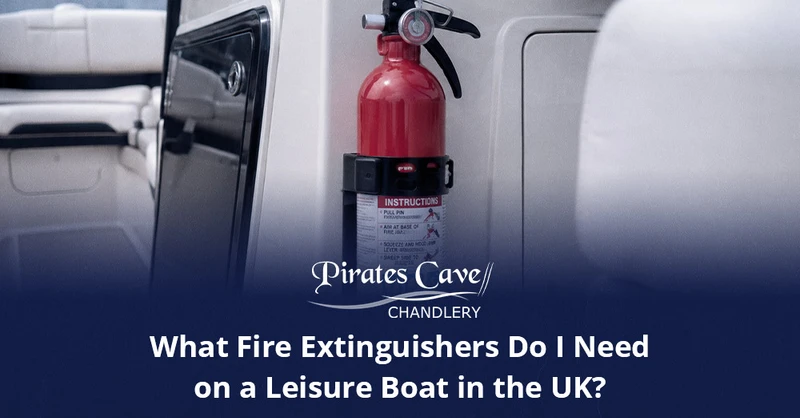
There is no single extinguisher number that applies to every UK leisure boat. The answer depends on the vessel’s length, whether it is a genuine private pleasure vessel, where it operates, whether the Boat Safety Scheme applies, and whether it is coded, chartered, raced or otherwise in commercial use.
For a private pleasure vessel under 13.7m going to sea, MCA guidance states that there is no general statutory carriage requirement for firefighting equipment, but owners should follow recognised small-craft safety guidance and provide equipment appropriate to the hazards. Vessels of 13.7m and over are Class XII vessels and have a separate regulatory or exemption framework. Inland boats subject to the Boat Safety Scheme must meet the current BSS checks.
Pirates Cave offers boat fire extinguishers and blankets, alongside fire and gas safety equipment and the wider marine safety range.
Do not begin with boat length alone. First identify which legal or inspection regime applies, then assess actual hazards: petrol, diesel, LPG, cooking oil, batteries, shore power, heaters, engines and enclosed accommodation.
Contents
- Key facts at a glance
- Which UK rules apply?
- Indicative RYA recommendations
- Fire classes and extinguisher media
- Where extinguishers should be located
- Engine-space fire protection
- Galley fires and fire blankets
- Electrical and battery fires
- Prevention and escape planning
- Inspection, servicing and replacement
- Fire-extinguisher buying checklist
- Frequently asked questions
- Technical references
Key facts at a glance
- Private pleasure vessels under 13.7m at sea are not covered by a general statutory requirement to carry firefighting appliances, according to current MCA guidance, but suitable equipment remains essential good practice.
- Private pleasure vessels of 13.7m and over are Class XII vessels and must follow the applicable regulations or general exemption.
- Inland boats on participating waterways may need a valid Boat Safety Scheme certificate and BSS-compliant extinguishers.
- Commercial, coded, charter, training and work boats have different requirements.
- An extinguisher rating such as 5A/34B describes tested capability, not simply cylinder size.
- Equipment should cover the fire risks present and remain reachable without passing through the fire.
- A fire blanket belongs near a galley exit, not directly above a cooker where flames may block access.
- Opening an engine hatch can feed a fire with oxygen. Use a designed discharge port or fixed system where fitted.
- Dry powder is versatile but can severely reduce visibility and contaminate machinery in a confined cabin.
- Everyone on board should know how to raise the alarm, stop fuel and power where safe, use equipment and abandon the vessel.
Which fire-extinguisher rules apply to your boat?
| Vessel or operation | Main framework to check | Practical implication |
|---|---|---|
| Private pleasure vessel under 13.7m operating at sea | MCA MGN 599 and current RYA/British Marine small-craft guidance | No general statutory carriage scale, but owner should carry equipment appropriate to hazards |
| Private pleasure vessel 13.7m or longer | Class XII fire-protection regulations or current MCA General Exemption | Specific quantities, ratings and other equipment apply |
| Boat on waterways covered by the Boat Safety Scheme | Current BSS Examination Checking Procedures and navigation-authority rules | Minimum numbers, combined ratings, certification marks, condition and location are examined |
| Commercially operated, coded or charter vessel | Applicable small-commercial-vessel code, workboat code or local authority requirements | Do not use a private-pleasure-vessel table |
| Race or organised-event entry | Notice of race, sailing instructions and governing-body requirements | Event rules can require additional equipment |
| Foreign-flagged or cruising abroad | Flag-state and coastal-state requirements | UK guidance may not be sufficient |
Confirm the vessel’s legal status carefully. Payment is not the only test of commercial use, and lending, charter, instruction or business activity can change the applicable framework.
Regulatory date check: this guide was prepared in August 2026. Before publication and before equipping a Class XII, coded or BSS boat, open the current official document rather than relying on a saved screenshot or an old extinguisher table.
Indicative RYA extinguisher recommendations for smaller leisure boats
The RYA’s current fire-safety article gives the following general recommendations for boats below 13.7m. These are guidance, not a universal legal carriage scale, and actual hazards may require more equipment.
| Approximate boat length | Indicative number of portable extinguishers | Indicative combined A/B fire rating | Additional considerations |
|---|---|---|---|
| Under 7m / 23ft | 2 | 10A / 68B | A small open boat with no cooker or internal-combustion engine may have a different risk assessment |
| 7m to 11m / 23ft to 36ft | 2 | 13A / 89B | Consider one extinguisher accessible to each sleeping cabin and separate engine/galley risks |
| 11m to 13.7m / 36ft to 45ft | 3 | 21A / 144B | Larger accommodation, machinery and escape routes may justify additional units |
The combined rating is found by adding compatible ratings across the available extinguishers. For example, two extinguishers each rated 5A/34B provide a combined 10A/68B rating. Placement still matters: two units locked together in one inaccessible locker do not provide good coverage.
Which extinguisher type works on which fire?
| Fire type | Typical boat examples | Potential extinguishing media | Critical caution |
|---|---|---|---|
| Class A: solid materials | Timber, paper, textiles and some furnishings | Water mist, water, foam, dry powder and certain clean agents as rated | Check electrical involvement before using conductive water-based media |
| Class B: flammable liquids | Petrol, diesel, paint and solvents | Foam, dry powder, CO2 or suitable clean agent as rated | Stop fuel supply if safe; do not spread burning liquid |
| Class F: cooking oils and fats | Galley pan fire | Wet-chemical extinguisher or suitable fire blanket | Never throw water onto burning cooking oil |
| Electrical equipment energised | Shore-power panel, charger, motor or appliance | CO2, dry powder or approved clean agent; isolate power if safe | Electricity is the source, not a permanent fire class; burning materials still need suitable media |
| Gas-fed flame | LPG appliance or leaking gas | Shut gas supply if safely possible and use suitable extinguisher | Extinguishing the flame without stopping gas can allow an explosive cloud to form |
| Lithium-ion battery | Portable power station, tool, device or propulsion battery | Follow manufacturer and fire-service guidance; cooling and evacuation may dominate | Re-ignition and toxic gases are possible; small handheld extinguishers may not stop cell propagation |
Dry powder
Dry powder is versatile and commonly rated for A and B risks, but discharge creates a dense cloud, impairs breathing and visibility, and can damage engines and electronics. In a small cabin, the operator must preserve an escape route.
Foam
Foam can be effective on Class A and suitable Class B fires, depending on its rating. Check storage temperature and whether the model is approved around live electrical equipment. Never generalise from the word “foam” alone.
CO2
CO2 leaves little residue and is useful around certain electrical and liquid risks, but it provides limited cooling and can disperse rapidly in the open. In a confined space it can displace breathable air. Use only as trained and rated.
Water mist and clean agents
Some water-mist and clean-agent extinguishers offer broad marine applications with less residue. Verify their exact fire ratings, certification, temperature range and suitability for the boat’s risks.
Where should fire extinguishers be mounted?
Mount portable extinguishers:
- near exits and escape routes
- where they can be reached before entering the risk area
- in visible, marked brackets
- away from direct weather, salt spray and extreme heat
- at a practical height and orientation stated by the maker
- where a falling cylinder cannot injure crew
Do not mount the only galley extinguisher directly above or behind the cooker. Do not mount the only engine extinguisher inside an engine compartment that must be opened during the fire.
Cabins and sleeping accommodation
Consider whether a sleeping person can reach an extinguisher and exit without moving towards the likely fire. Smoke alarms, carbon-monoxide alarms and emergency lighting support early escape but require suitable marine installation and regular tests.
How should an engine-space fire be tackled?
Prevention and early isolation are critical. Maintain fuel hoses, filters, exhaust insulation, battery cables, alternator connections and bilge cleanliness. Know the location of fuel shutoffs, electrical isolators and ventilation controls.
Opening a hatch can introduce oxygen and produce a flare-up. A well-designed engine space may have:
- a fixed automatic or manually released suppression system
- an external fire-extinguisher discharge port
- remote fuel shutoff
- engine and ventilation shutdown
- fire-resistant construction and detection
Only use a discharge port with an extinguisher and system designed for it. Do not drill a random hole or assume a portable unit has enough agent for the compartment volume.
What should be carried for a galley fire?
Keep an approved fire blanket where it can be reached from the escape side of the galley. It is suitable for smothering a small pan fire when the operator can approach safely and has been trained.
- Raise the alarm.
- Turn off heat and gas only if safely reachable.
- Do not move a burning pan.
- Do not use water on burning oil or fat.
- Use the blanket by protecting hands and placing it over the pan.
- Leave it covered and monitor for re-ignition.
- Evacuate and call for help if the fire is not immediately controlled.
A fire blanket is not a substitute for extinguishers elsewhere, and a contaminated or used blanket should be replaced.
Electrical and battery fire considerations
Loose high-current connections, undersized cables, poor fusing, damaged shore-power leads and inappropriate chargers can start fires. Have systems inspected when terminals show heat discolouration, insulation is brittle, breakers trip or batteries swell.
Battery chemistry matters:
- lead-acid charging can produce explosive hydrogen
- short circuits can deliver extremely high current
- lithium-ion thermal runaway can spread between cells and re-ignite
- saltwater-damaged lithium equipment can develop delayed faults
Do not open a battery enclosure or handle a hot, hissing or swollen battery. Move people to safety and call emergency services. Follow the propulsion or battery manufacturer’s emergency plan for large lithium installations.
Fire prevention and escape planning
- Install and test suitable smoke, heat, gas and carbon-monoxide alarms.
- Keep two practicable escape routes from accommodation where the vessel design permits.
- Store petrol and flammable liquids in an approved locker that drains and vents safely.
- Turn off LPG at the cylinder when not in use and maintain the system.
- Keep bilges free of fuel and oil.
- Do not charge damaged batteries or devices unattended.
- Keep exits, hatches and extinguisher brackets unobstructed.
- Brief guests before departure.
- Practise a Mayday and abandonment sequence.
Firefighting should not trap the operator. If the fire is not immediately controllable, raise the alarm, send a distress call, get everyone into lifejackets and prepare to abandon safely.
How should boat extinguishers be inspected?
| Check | Look for | Action |
|---|---|---|
| Gauge or indicator | Outside permitted zone or damaged indicator | Remove from service and have it assessed |
| Safety pin and tamper seal | Missing, bent or disturbed | Investigate and replace/service |
| Cylinder | Rust, dents, abrasion, heat damage or leakage | Professional inspection or replacement |
| Hose/nozzle | Blockage, cracking or insect contamination | Clean only as permitted; replace damaged parts |
| Bracket | Loose, corroded or wrong size | Renew and mount securely |
| Label and rating | Illegible instructions or missing certification | Replace with an identifiable approved unit |
| Mass | Loss from specified full weight where weighing is required | Service or replace |
| Service/expiry information | Date passed or interval due | Use an approved service agent/manufacturer route |
Turn or shake dry-powder extinguishers only if the manufacturer or service guidance instructs it. Do not use internet rituals in place of proper service. Marine vibration and damp can shorten useful life.
Boat fire-extinguisher buying checklist
- Confirm private, BSS, Class XII, coded or other status.
- List fire hazards by compartment.
- Calculate required or recommended A/B combined rating.
- Add Class F provision for cooking-oil risk.
- Choose media appropriate to machinery, accommodation and electrical equipment.
- Plan positions around exits, not only around hazards.
- Check recognised certification markings required by the relevant regime.
- Confirm operating-temperature range and bracket suitability.
- Assess fixed engine-space protection separately.
- Set inspection and service dates in the boat log.
Equip the boat around its real fire risks
Browse fire extinguishers and blankets, plus alarms and gas-detection products in fire and gas safety.
Before ordering, identify the boat length, legal/inspection regime, engine and fuel, LPG and cooking equipment, accommodation layout, current extinguisher ratings and engine-space volume. Contact Pirates Cave for product help; use a BSS examiner, surveyor or fire-safety professional where required.
Frequently asked questions about boat fire extinguishers
Are fire extinguishers legally required on a UK leisure boat?
It depends. MCA guidance says private pleasure vessels under 13.7m at sea have no general statutory carriage requirement. Class XII vessels, coded boats and vessels subject to the Boat Safety Scheme have specific frameworks. Suitable equipment remains essential good practice on every boat with fire hazards.
How many extinguishers does a 30ft boat need?
RYA guidance for boats from 7m to 11m indicates two extinguishers with a combined rating of 13A/89B, but this is a general recommendation rather than a universal rule. Add protection for the actual engine, galley, cabins and legal regime.
What do 5A and 34B mean?
The letter identifies the fire class and the number indicates tested extinguishing capability. Higher numbers represent greater capability within that class. Ratings can be added across suitable portable units to calculate a combined rating.
Is dry powder the best extinguisher for a boat?
It is versatile and widely used, but discharge in a small cabin can obscure vision, affect breathing and contaminate machinery. A mixed provision of correctly rated media may be more appropriate after assessing the risks.
Can I use a CO2 extinguisher on an electrical fire?
CO2 can be suitable for certain energised electrical equipment and leaves little residue. It provides limited cooling, can allow re-ignition and can displace air in a confined space. Isolate power if safe and use only a correctly rated unit.
Where should a fire blanket be mounted?
Near the galley exit, where it can be reached without leaning over the cooker or fire. The cover should be visible, secure and quick to open. Do not hide it in a drawer beneath the hob.
Can I open the engine hatch to use an extinguisher?
Opening the hatch may supply oxygen and cause a dangerous flare-up. Use a designed discharge port or fixed system where fitted. Follow the vessel’s emergency procedure and do not compromise your escape route.
Do extinguishers expire?
Service life and intervals depend on type, manufacturer, certification and applicable scheme. Corrosion, pressure loss or damage can require earlier replacement. Follow the label, service agent and BSS or coding requirements.
Does the Boat Safety Scheme require particular markings?
The BSS checks accepted certification marks, ratings, condition and other details. Use the current Examination Checking Procedures because accepted markings and requirements can be updated. A generic CE mark alone may not demonstrate the required performance approval.
Can a normal household extinguisher be used on a boat?
Only if it has the required certification, rating, temperature range, corrosion resistance and mounting arrangement for the applicable boat regime. A marine environment exposes cylinders to vibration, damp and salt.
What extinguisher is suitable for a lithium battery fire?
Lithium battery incidents differ by chemistry and size. Small consumer devices and large propulsion banks require different plans; cooling, isolation, evacuation and fire-service support may be critical. Follow the battery manufacturer and emergency-service guidance.
Should every cabin have an extinguisher?
The key is that occupants can reach suitable equipment while retaining an escape route. The RYA suggests considering one for each sleeping cabin, but layout and hazards determine final placement.
What should I do after using an extinguisher?
Keep watch for re-ignition, ventilate only when safe, obtain medical advice for smoke or powder exposure, and have the vessel inspected. Replace or service the discharged unit before the boat returns to use.
Technical references
- Maritime and Coastguard Agency: MGN 599 Amendment 1
- Royal Yachting Association: Fire safety on boats
- Royal Yachting Association: Class XII fire-protection exemption guidance
- Boat Safety Scheme: Current requirements and examination information
Important: This article distinguishes general recommendations from legal requirements but cannot determine a vessel’s status. Check current MCA, BSS, coding, flag-state, race and local rules. Firefighting must never prevent immediate evacuation, distress alerting or safe abandonment.