25th Sep 2026
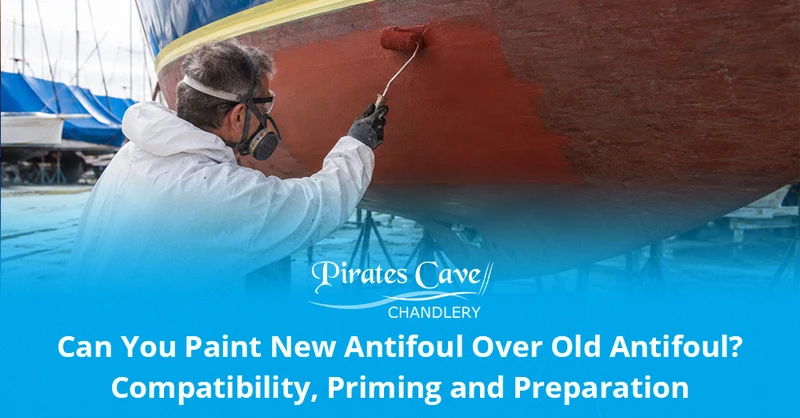
You can often apply new antifouling over an existing coating, but only when the old antifoul is sound and the exact coating system is compatible. If the old product is unknown, a manufacturer-approved barrier or tie-coat primer may be required. If the coating is flaking, blistered, excessively thick or poorly attached, painting over it will normally preserve the problem rather than solve it.
The safest route is to identify the existing antifouling, inspect its condition and check the latest compatibility chart and technical data sheet for the new product. Pirates Cave stocks antifouling paint, marine primers and undercoats, preparation tools and application equipment.
The essential rule: compatibility and condition are separate questions. A chemically compatible antifouling can still fail when applied over a weak, contaminated or excessively built-up surface.
Contents
- Key facts at a glance
- Antifouling overcoat decision tree
- How to identify the old antifouling
- How to assess the existing coating
- How antifouling compatibility works
- Hard vs self-polishing antifouling
- What to do when the old product is unknown
- Step-by-step surface preparation
- When a primer or barrier coat is needed
- Applying the new antifouling
- Guidance for different hull materials
- Safety and environmental precautions
- Common mistakes
- Pre-purchase checklist
- Frequently asked questions
- Technical references
Key facts at a glance
- Do not assume two antifoulings are compatible because they are the same colour or from the same brand.
- Use the current compatibility chart and technical data sheet for the product you intend to apply.
- A sound coating is firmly attached, reasonably even and free from widespread flaking, blistering or cracking.
- Pressure-wash or clean the hull as soon as practical after lift-out, before marine growth dries hard.
- Unknown but sound antifouling is commonly isolated with a specified barrier or tie-coat primer, but the required product and preparation are system-specific.
- Loose, failing or excessively thick coating should be removed back to a stable layer or substrate.
- Bare GRP, steel, aluminium, timber and previously epoxied surfaces require different preparation and primer systems.
- Propellers, sterngear, aluminium drives and conventional hull antifouling are not automatically treated with the same products.
- Observe minimum and maximum overcoating intervals, number of coats, film build and launch window.
- Antifouling contains active substances. Follow the label, safety data sheet, boatyard rules and local waste controls.
For a broader explanation of coating types, coverage and application planning, also read The Ultimate Antifouling Paint Guide.
Can new antifouling go over the old coating?
| Existing surface | Likely route | What to confirm before painting |
|---|---|---|
| Known product, sound condition and listed as directly compatible | Clean and prepare exactly as stated, then overcoat | Required washing, abrasion, number of coats and overcoat/launch times |
| Known product, sound condition but primer is specified | Prepare and apply the named tie coat or barrier primer | Primer compatibility with both old and new systems; overcoat window |
| Unknown antifouling, sound and firmly attached | Often clean, prepare and isolate with the new manufacturer’s specified barrier primer | Do not select a generic primer by guesswork; obtain written product guidance |
| Flaking, blistered, cracked, soft or poorly attached coating | Remove all failed material and continue until a stable surface is reached | Whether full removal is needed; how the exposed substrate must be primed |
| Very thick build-up with multiple unknown layers | Consider controlled removal rather than adding another season of paint | Hull condition, removal method, environmental containment and new full coating system |
| Silicone or foul-release coating | Treat as a specialist system | Do not apply ordinary antifouling unless the system manufacturer provides a conversion procedure |
| Bare substrate or extensive exposed patches | Use the complete primer and antifouling specification for that material | Moisture, corrosion, osmosis, timber condition and minimum primer film build |
Do not rely on a thumbnail test alone. Scratching a small area can reveal adhesion and colour layers, but it cannot prove chemical compatibility. Use it alongside product records, invoices, photographs and current manufacturer guidance.
How do you identify old antifouling?
Identification is easiest when the boat has a maintenance record. Look for:
- previous invoices or chandlery receipts
- part-used tins with a readable batch and product label
- boatyard work sheets
- photographs taken during the previous application
- notes in the vessel maintenance log
- information from the previous owner or surveyor
Record the full product name, not merely the manufacturer. A brand may offer hard, polishing, high-performance, aluminium-safe and specialist antifoulings with different compatibility rules.
Can colour identify the product?
No. Many antifoulings are available in similar shades, and immersion can change their appearance. An old red layer beneath a blue top coat shows the coating history but does not identify either formulation reliably.
Can rubbing the surface show whether it is self-polishing?
A self-polishing or eroding coating may produce coloured residue when wet-rubbed, while a hard coating may remain more intact. This is only a clue. Weathering, fouling, sanding and old mixed layers can make the result misleading.
What if the previous owner does not know?
Treat the product as unknown. Check whether the coating itself is stable, then follow the new antifouling manufacturer’s published unknown-coating procedure. That commonly involves cleaning, controlled abrasion if permitted and an approved sealer or barrier primer.
How do you know whether the old antifouling is sound?
Inspect the entire underwater area under good lighting after washing. Pay particular attention to the waterline, leading edge of the keel, rudder, chines, bow, stern, around supports and areas repeatedly pressure-washed.
| Observation | What it may mean | Recommended response |
|---|---|---|
| Even, firmly attached coating with normal polishing or wear | Suitable candidate for overcoating if compatible | Clean and prepare to the new product instructions |
| Small isolated chips with solid surrounding edges | Local impact or preparation defect | Feather sound edges and spot-prime exposed substrate with the specified primer |
| Widespread flaking or sheets lifting | Weak adhesion within an earlier layer | Remove until firmly bonded material is reached; full removal may be more efficient |
| Cracking or a dry river-bed pattern | Excessive film build, incompatible layers or ageing | Do not bridge with more paint; investigate and remove unstable build-up |
| Soft, sticky or easily scraped coating | Solvent entrapment, incompatible chemistry or degraded material | Seek manufacturer advice; removal is often required |
| Blisters beneath the coating | Could involve trapped moisture, corrosion or laminate issues | Do not simply burst and paint; identify the layer and underlying cause |
| Rust on steel or aluminium corrosion products | Primer system has failed or metal is exposed | Prepare metal to the specified standard and rebuild the approved primer system |
| Moisture or laminate damage suspected in GRP | Potential osmosis or structural issue | Obtain competent assessment before sealing it beneath new paint |
Adhesion checks
A boatyard or coating manufacturer may recommend a small cross-cut or scrape test in representative areas. The purpose is to see whether layers detach cleanly from one another. Avoid damaging laminate or metal, and do not treat one successful patch as proof that the whole hull is sound.
Why excessive build-up matters
Each additional coat adds weight and places fresh paint over the weakest historic layer. A hull can appear acceptable until pressure washing or sailing loads release multiple seasons at once. Planned removal during a refit may be more economical than repeated local repairs.
What does antifouling compatibility actually mean?
Compatibility means the proposed new coating can adhere to and cure over the existing system after the prescribed preparation. It does not mean every product in the same broad category can be mixed freely.
Compatibility depends on:
- the exact old and new formulations
- whether the existing paint is fully cured or still active
- the condition and thickness of historic layers
- required cleaning and surface profile
- the tie-coat or primer specified between systems
- temperature, humidity and application conditions
- minimum and maximum recoat times
Manufacturers reformulate, rename and replace products. Use a current chart for the market in which the paint is sold, and confirm advice when an old discontinued product appears in the coating history.
Can hard antifouling go over self-polishing antifouling?
Sometimes, but not as a universal rule. A hard antifouling can place a relatively rigid film over a softer or eroding layer. Some product combinations require the older coating to be removed or isolated; others are approved after specific preparation.
Can self-polishing antifouling go over hard antifouling?
Often this is possible when the hard coating is sound and the manufacturer lists the combination, but cleaning and abrasion may be required. The current product chart must decide the route.
| Coating type | How it behaves | Compatibility consideration |
|---|---|---|
| Hard antifouling | Creates a durable film that resists erosion | Can build up over repeated seasons; surface profile and adhesion are important |
| Self-polishing or eroding antifouling | Controlled surface renewal exposes active material | Old depleted material may need thorough cleaning or wet abrasion before overcoating |
| Thin-film or low-friction system | Uses a specialised, relatively smooth film | Often has a narrow approved overcoat system |
| Silicone foul-release | Relies on a low-surface-energy elastomer rather than conventional biocide release | Normally requires dedicated primers and conversion products; ordinary paint may not adhere |
| Propeller or drive coating | Designed for small, fast-moving metal components | Substrate and primer requirements differ from conventional hull antifouling |
What should you do when the old antifouling is unknown?
- Wash and inspect. Establish whether the surface is genuinely stable.
- Remove all loose material. Feather edges without leaving polished, unsupported lips.
- Ask the new paint manufacturer for its unknown-coating system. Provide the hull material and intended product.
- Use only the named barrier or tie-coat primer. The primer must be approved over the old coating and beneath the new antifouling.
- Follow the primer preparation and window. Too little film or an expired recoat window can defeat the purpose.
- Document the new system. Record products, colours, batch numbers, coats and dates for next season.
A barrier primer is not a repair film. It can isolate a sound unknown or incompatible coating where the manufacturer permits, but it cannot stabilise flaking layers or cure trapped moisture.
How to prepare old antifouling for a new coat
- Read the label, data sheet and yard rules before starting. Plan PPE, weather, drying time and waste collection.
- Pressure-wash promptly after lift-out. Remove slime and fouling while wet, using a pressure and distance appropriate for the hull and coating.
- Allow the hull to dry enough for inspection. Mark defects with chalk or tape.
- Confirm compatibility. Do this before sanding the entire boat or purchasing the complete system.
- Remove loose or failed coating. Use the method permitted by the product, yard and substrate.
- Clean contamination. Salt, grease, wax and polishing residue can undermine adhesion. Use only the cleaner or solvent specified.
- Abrade where instructed. Many systems call for wet sanding or controlled dust extraction. Do not dry-sand antifouling casually.
- Feather repair edges. Avoid sharp steps that remain visible through the new film.
- Prime exposed substrate and repairs. GRP, epoxy, steel, aluminium and timber may each require a different product.
- Apply a full barrier coat where required. Achieve the specified film build rather than a transparent mist coat.
- Remove dust and residue. Use the approved final cleaning method without recontaminating the surface.
- Paint inside the weather window. Surface temperature, dew point, humidity and forecast matter.
Should old antifouling be wet-sanded?
Wet sanding reduces airborne dust and is specified for many conventional antifouling systems, but it is not appropriate in every location or for every coating. Use containment, collect the slurry and follow the label and boatyard environmental controls.
Can you pressure-wash antifouling too aggressively?
Yes. A close, concentrated jet can cut through sound paint, damage soft timber, force water into defects or scar GRP. The goal is to remove fouling and weak material, not to carve an uneven surface.
When is an antifouling primer or barrier coat needed?
| Situation | Typical primer role | Important limitation |
|---|---|---|
| Unknown but sound old antifouling | Isolates the historic coating and provides a known base | Must be the new system manufacturer’s approved product |
| Incompatible known products | Creates a compatible transition between systems | Only where a published conversion route exists |
| Bare GRP or epoxy repair | Promotes adhesion and can contribute to moisture protection | A single tie coat is not automatically an osmosis-prevention scheme |
| Bare steel | Restores corrosion protection and adhesion | Surface preparation standard and dry-film thickness are critical |
| Bare aluminium | Provides adhesion and corrosion control without harmful metals | Use an aluminium-approved complete system and antifouling |
| Bare timber | Seals and prepares the timber while accommodating movement | Moisture content and species/system suitability matter |
| Spot repairs through old coating | Rebuilds protection only where substrate is exposed | Feather edges and observe overlap instructions |
| Silicone foul-release conversion | Part of a proprietary conversion system | Generic underwater primer is not enough |
Browse boat primers and undercoats only after identifying the substrate and new antifouling system. A product described as an underwater primer is not automatically compatible with every antifoul.
Applying the new antifouling correctly
- Stir thoroughly, including material settled at the bottom of the tin.
- Use the specified roller, brush or professional spray method.
- Apply the stated number of full coats at the stated coverage rate.
- Add an extra coat to high-wear areas only where the instructions recommend it.
- Do not stretch the paint to cover a larger area than its calculated yield.
- Respect the minimum and maximum interval between primer and antifouling coats.
- Record the time and conditions at each coat.
- Observe the minimum drying period and maximum launch window.
- Remove masking tape at the stage advised for the coating.
- Retain labels and a small record of the system for future maintenance.
How much antifouling should you apply?
Calculate wetted area and use the manufacturer’s stated practical coverage and number of coats. Film thickness is part of performance. A hull that looks uniformly coloured may still have received too little product.
Can you mix leftover tins?
Do not mix different antifouling products or batches casually. Even similar products can use different binders, solvents and active ingredients. Use only combinations explicitly approved by the manufacturer.
Antifouling overcoating by hull and component material
| Surface | Main concern | Good practice |
|---|---|---|
| GRP/fibreglass | Adhesion, osmosis symptoms and damage to gelcoat | Investigate blisters; avoid aggressive grinding; use the specified GRP/epoxy primer system |
| Steel | Corrosion beneath damaged coating | Remove corrosion to the specified preparation standard and rebuild the full anticorrosive primer film |
| Aluminium | Galvanic corrosion and copper-containing product restrictions | Use only an aluminium-approved primer and antifouling system; isolate dissimilar metals correctly |
| Timber | Moisture and movement | Assess timber condition and moisture; use a compatible flexible system approved for the species and construction |
| Epoxy-coated hull | Maintaining the barrier layer | Repair exposed or damaged epoxy before tie-coating and antifouling |
| Propeller, shaft or sterngear | High speed, metal compatibility and poor adhesion | Use a dedicated propeller/drive system where approved; protect anodes from all coating |
| Outboard, sterndrive or saildrive | Aluminium housings, manufacturer warranty and cooling openings | Follow the propulsion manufacturer; mask anodes, seals, sensors and water intakes |
Never paint or antifoul sacrificial anodes. If corrosion protection is unfamiliar, refer to The Ultimate Boat Anode Guide.
Antifouling safety and environmental precautions
- Read the product label and safety data sheet before opening the tin.
- Wear the specified gloves, eye protection, coveralls and respiratory protection.
- Provide ventilation and remove ignition sources when solvents are present.
- Do not eat, drink or smoke in the work area.
- Use ground sheets, screens and extraction to contain chips, dust and slurry.
- Prevent paint, wash water and sanding residue entering drains, soil or the marina.
- Dispose of paint, contaminated liquid, filters and abrasive waste through approved routes.
- Do not burn or mechanically remove coatings in ways prohibited by the manufacturer or yard.
- Keep people and animals away until the work area is clean and the coating is cured.
Safety warning: antifouling removal can expose hazardous dust and biocides. Large-scale stripping, blasting, spraying and work on uncertain historic coatings should be planned and controlled by competent professionals.
Common antifouling overcoating mistakes
| Mistake | Why it causes failure | Better approach |
|---|---|---|
| Buying paint before checking the old system | The chosen product may require a different primer or complete removal | Identify and verify compatibility first |
| Painting over flaking edges | The new film is attached only as strongly as the failed layer beneath | Remove and feather back to sound coating |
| Using any available primer | It may be incompatible above or below | Use the exact primer named in the conversion system |
| Dry sanding without controls | Creates hazardous dust and contamination | Use the approved controlled method and yard facilities |
| Skipping washing because the hull looks clean | Salt, slime, grease and residue remain | Follow the cleaning sequence in the data sheet |
| Applying one thin cosmetic coat | Insufficient dry-film thickness shortens service life | Apply the full specified coat count and coverage |
| Ignoring the launch window | The coating may be too soft, over-cured or outside its activation period | Record application times and schedule launch accordingly |
| Coating anodes or drive openings | Can disable corrosion protection or cooling | Mask all excluded components carefully |
Antifouling compatibility and buying checklist
- Record old product name if known.
- Photograph the washed hull and all defects.
- Identify hull and underwater component materials.
- Assess whether the old coating is sound.
- Select the new antifouling for boat speed, use, water and material.
- Check the current compatibility chart.
- Confirm cleaning and abrasion requirements.
- Choose the exact tie coat, barrier primer and spot primer required.
- Calculate wetted area, coat count and practical coverage.
- Check application temperature, overcoat interval and launch window.
- Arrange PPE, masking, rollers and waste containment.
- Write the new system into the maintenance log.
Build a compatible antifouling system
Browse the full range of antifouling paint, primers and undercoats and paint brushes and rollers.
Before ordering, note the hull material, old product, coating condition, boat speed, water type and intended launch date. Contact Pirates Cave when the existing system is uncertain; severe coating failure, corrosion or laminate defects may require a surveyor or professional boatyard.
Frequently asked questions about painting over old antifouling
Can I put new antifouling straight over old antifouling?
Only when the old coating is sound and the product manufacturer confirms direct compatibility after the stated preparation. Otherwise you may need abrasion, a barrier primer or removal. Never use appearance alone to decide.
What happens if antifoulings are incompatible?
The new film may wrinkle, remain soft, lose adhesion, crack or detach with the older layer. Failure may appear during application, after launch or at the next pressure wash.
Can I change antifouling brands?
Yes, provided the proposed cross-brand combination appears on a current compatibility chart or the manufacturer gives an approved conversion system. Brand change often requires a tie coat when the old product is unknown.
Do I need to remove all old antifouling?
Not when the existing coating is thin, sound and compatible. Full or extensive removal is appropriate when layers are unstable, excessively thick, cracked, contaminated or part of an incompatible specialist system.
How can I tell if old antifouling is hard or self-polishing?
Maintenance records are the best evidence. Wet rubbing and the way the surface wears can provide clues, but they cannot identify the exact product. Treat uncertainty as an unknown coating.
Can hard antifouling be applied over self-polishing paint?
Only where the exact manufacturer guidance permits it. A hard film over a soft eroding base can fail, so removal or a specified conversion primer may be required.
Can self-polishing antifouling go over hard paint?
Often, but not always. The hard coating must be firmly attached, clean and prepared to the new product instructions. Some systems require abrasion or a tie coat.
Which primer should I use over unknown antifouling?
Use the barrier or tie-coat primer specified by the manufacturer of the new antifouling for unknown existing coatings. Do not substitute a general primer without written confirmation.
Should I sand before applying antifouling?
Many products require controlled abrasion, while some allow direct overcoating after washing within a stated interval. Follow the specific data sheet. Where sanding is required, use the stated method and contain hazardous residue.
Can antifouling be applied over a damp hull?
Normally the prepared surface must meet the product’s dryness, temperature and dew-point requirements. Painting over moisture can cause poor adhesion or blistering. Moisture within GRP, timber or corrosion damage needs separate assessment.
Can I antifoul over silicone foul-release paint?
Not with ordinary antifouling unless the foul-release system manufacturer publishes a conversion procedure. Silicone surfaces have very low surface energy and require dedicated preparation and primers.
Can I use hull antifouling on an aluminium outdrive?
Only when the product is specifically approved for aluminium drives and the equipment manufacturer permits it. Many conventional copper-containing products are unsuitable. Use the correct primer and keep anodes and openings unpainted.
Why did my antifouling come off during pressure washing?
The pressure may have been excessive, or the coating may have had poor adhesion, contamination, incompatible layers or too much historic build-up. Remove all loosened material and investigate before repainting.
How long after antifouling can the boat be launched?
The minimum drying time and maximum launch interval are product-specific and depend on temperature. Use the current data sheet and record the final coat time rather than relying on a general rule.
Technical references
- International Yacht Paint: Antifouling compatibility guidance
- Seajet: Antifouling compatibility table
- Health and Safety Executive: Control of substances hazardous to health
Important: Product formulations, compatibility charts and application windows can change. Confirm the current UK label, technical data sheet and safety data sheet for every product before work. Follow boatyard environmental rules and obtain professional advice for extensive stripping, corrosion, osmosis, timber damage or specialist foul-release systems.