23rd Oct 2026
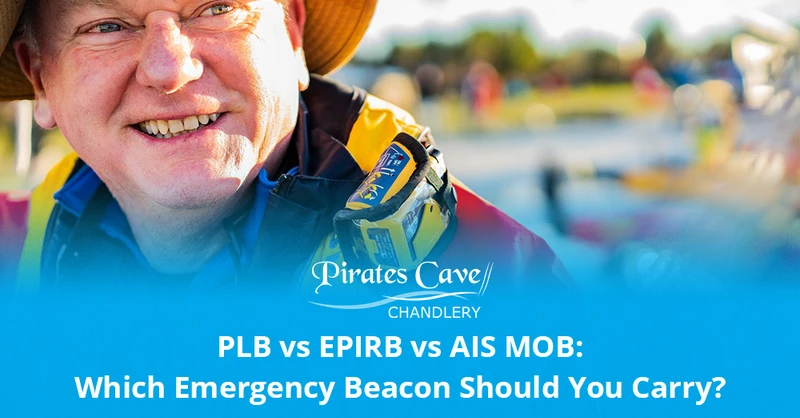
A PLB and an EPIRB send a 406MHz distress alert through the international Cospas-Sarsat satellite system towards search-and-rescue authorities. An AIS MOB beacon transmits a local man-overboard target to compatible AIS equipment within VHF range. They therefore solve different parts of an emergency and are often best treated as complementary rather than interchangeable.
Choose an EPIRB primarily for vessel-level distress and abandonment, a PLB for distress equipment carried by an individual, and an AIS MOB for rapid local detection by your own boat and nearby AIS-equipped vessels. Some new products combine 406MHz, AIS, Return Link Service and other functions, so the label alone is not enough: compare the actual alert paths and activation method.
Pirates Cave stocks PLBs and EPIRBs, as well as complementary AIS equipment, marine VHF radios, lifejackets and other boat safety equipment.
The fastest way to understand the choice: ask who needs to receive the first alert. A 406MHz beacon reaches the satellite search-and-rescue system; an AIS MOB reaches compatible local receivers. A product with both can provide both alert paths, subject to its exact specification.
Contents
- Key facts at a glance
- PLB vs EPIRB vs AIS MOB comparison
- Who receives each alert?
- What is a PLB?
- What is an EPIRB?
- What is an AIS MOB beacon?
- Combined 406MHz and AIS beacons
- Which beacon suits different boaters?
- UK registration and coding
- Lifejacket integration and activation
- Testing, battery and maintenance
- Building a layered distress plan
- Frequently asked questions
- Technical references
Key facts at a glance
- PLBs and EPIRBs use 406MHz Cospas-Sarsat satellite distress alerting.
- AIS MOB beacons transmit a local AIS safety target and message; they are not automatically the same as a satellite beacon.
- An EPIRB is normally registered to a vessel and is designed as vessel-level emergency equipment.
- A PLB is compact personal equipment, normally manually activated and carried on the individual.
- Traditional PLBs may not float in an operating position without support; check the exact product rather than assuming buoyancy.
- Some EPIRBs are manually released; others use a float-free housing and hydrostatic release.
- Some AIS MOB products can also send DSC alerts, but compatibility and programming conditions vary.
- Newer PLBs and EPIRBs may combine AIS, Return Link Service, GNSS and near-field smartphone diagnostics.
- UK-coded 406MHz EPIRBs and PLBs must be registered with current owner, vessel and emergency-contact information as applicable.
- No beacon replaces a VHF Mayday, lifejacket, distress plan, flares where carried, or prevention of a person-overboard incident.
PLB vs EPIRB vs AIS MOB comparison table
| Feature | PLB | EPIRB | AIS MOB beacon |
|---|---|---|---|
| Primary purpose | Personal satellite distress alert | Vessel-level satellite distress alert | Rapid local man-overboard location |
| Main alert network | 406MHz Cospas-Sarsat | 406MHz Cospas-Sarsat | AIS VHF transmissions to compatible nearby receivers |
| Who is identified | Registered person/beacon, with associated activity or vessel details | Registered vessel and beacon | MOB device target; exact displayed identity depends on product and receiver |
| Typical activation | Manual; some models can be semi-automatic in a compatible lifejacket | Manual or automatic/float-free depending on category and housing | Manual or automatic with a compatible inflated lifejacket depending on model |
| Buoyancy | Do not assume it will float upright and transmit correctly | Designed to float and transmit in its specified operating orientation | Varies; often intended to remain attached to the casualty/lifejacket |
| Typical endurance | Often around or above 24 hours, model dependent | Typically longer than a PLB, model dependent | Model dependent; check stated operating life |
| Local homing | Often 121.5MHz; newer models may add AIS | Often 121.5MHz; newer models may add AIS | AIS target; some models add DSC or other locating signals |
| Best-known strength | Compact and carried on the person | Robust vessel distress alert and abandonment use | Your own vessel can see and navigate back to the casualty quickly |
| Main limitation | Must be accessible and activated; may need support to keep antenna positioned | May remain with the vessel if not correctly located or carried to survival craft | Relies on compatible receivers within local radio range; not a global satellite alert unless combined with 406MHz |
Specifications change quickly. Read the current product manual for exact activation, flotation, transmission time, coding, lifejacket compatibility and test schedule.
Who receives each type of beacon alert?
406MHz PLB or EPIRB
The beacon transmits its unique digital identity on 406MHz. Cospas-Sarsat satellites and ground infrastructure relay the alert to the relevant rescue coordination system. Where the beacon includes GNSS, the encoded position can speed location. A 121.5MHz homing transmitter may help rescuers during the final approach.
AIS MOB
The device transmits an AIS target on marine VHF frequencies. Compatible plotters, AIS displays or software within range can show the casualty’s position. This is particularly valuable to the vessel from which the person fell, because the crew can begin a direct recovery immediately.
DSC-equipped MOB devices
Some products add a DSC alert. Whether the alarm is sent to one programmed vessel, a group or all stations can depend on product generation, approvals and local rules. Confirm compatibility with the boat’s VHF before relying on it.
An AIS MOB target does not automatically guarantee that the Coastguard has received a satellite distress alert. Unless the device also includes 406MHz or another recognised distress path, someone receiving the AIS/DSC alert must escalate the emergency appropriately.
What is a Personal Locator Beacon?
A PLB is a compact 406MHz distress beacon registered to a person or personal use arrangement. It is designed to be carried, not left in a locker. Sailors, solo boaters, RIB users, paddlers and crew moving between vessels often choose PLBs because the protection follows the individual.
PLB advantages
- small enough to attach to suitable personal flotation equipment
- works beyond normal VHF range through the satellite system
- registered emergency contacts can help rescue coordinators understand the user’s plans
- can be carried between activities when registration details remain accurate
- newer models may add AIS local alerting and Return Link Service
PLB limitations
- usually manual activation
- antenna must be deployed and held in the required orientation
- many traditional PLBs are not designed to float upright while transmitting
- battery endurance is generally shorter than a full-size EPIRB
- a PLB stored below deck is not personal protection
What is an EPIRB?
An Emergency Position Indicating Radio Beacon is primarily associated with a vessel. It is larger than a PLB, designed to float and transmit, and commonly offers longer operating endurance. It should be mounted where it can be reached quickly or, for an automatic category, released correctly if the vessel sinks.
Manual-release EPIRB
A manual bracket protects the beacon but requires a person to remove and activate it. Position it where crew can reach it on the route to the cockpit, deck or survival craft. Do not bury it behind equipment or mount it where fire could cut off access.
Float-free EPIRB
A float-free housing uses a hydrostatic release unit and approved mounting arrangement. If the vessel sinks, the beacon is intended to release and activate as designed. Installation height, obstructions, hydrostatic-release expiry and housing condition are critical.
EPIRB advantages
- strong vessel-level distress identity
- designed for operation afloat
- long operating life compared with many personal beacons
- manual or automatic release options
- new models may add AIS, RLS and smartphone diagnostics
What is an AIS MOB beacon?
An AIS MOB beacon is designed for the first urgent task after a person falls overboard: help the vessel and nearby traffic locate the casualty. When activated, it transmits a position and safety message that can appear as an AIS target on compatible displays.
The range is affected by antenna height, waves, the casualty’s position, receiver installation and local conditions. It is therefore a local system, not a promise of reception by every vessel or shore station.
When AIS MOB is especially valuable
- short-handed and solo sailing
- night passages or poor visibility
- offshore racing fleets with AIS-equipped boats
- cold water where recovery time is critical
- situations where the casualty can disappear from sight within seconds
The boat needs a compatible, switched-on AIS receiver and a crew procedure for recognising the alarm and initiating recovery. Test modes should be practised without transmitting a real distress message.
What are combined 406MHz and AIS beacons?
Some modern PLBs and EPIRBs include both satellite 406MHz alerting and AIS local locating. This combination can alert the wider search-and-rescue system while also helping nearby vessels find the casualty or beacon.
Possible additional features include:
- Return Link Service: an indication that the distress signal has been received through the compatible satellite system
- NFC diagnostics: smartphone access to test, battery and status information without activating the beacon
- visible and infrared strobes: final visual locating aids
- multi-constellation GNSS: position derived from compatible satellite-navigation systems
These features do not eliminate the need for correct registration, mounting, antenna deployment and crew training.
Which beacon should different boaters carry?
| Boating profile | Strong starting configuration | Reasoning |
|---|---|---|
| Sheltered day sailing with reliable VHF coverage | VHF plus personal flotation; consider PLB for additional independent alerting | A PLB provides a satellite route if VHF is lost or the person becomes separated |
| Solo or short-handed coastal sailing | Personal AIS MOB or combined PLB/AIS on the lifejacket, plus vessel VHF | Local return-to-casualty alert and an independent distress path are both valuable |
| Regular offshore cruising | Vessel EPIRB plus personal beacons for watchkeepers; VHF/MF/HF or satellite communications as appropriate | Vessel abandonment and individual separation need different layers |
| RIB, PWC, kayak or paddle craft | Body-worn PLB or combined personal beacon selected for the activity | The craft may not provide a secure, accessible EPIRB mounting point |
| Family motorboat cruising | Vessel EPIRB for longer or remote passages; PLB/AIS MOB for exposed deck work | The correct mix depends on distance from help and crew recovery ability |
| Charter, coded or racing vessel | Equipment required by the applicable code or race rules, then additional personal layers | Regulatory and event requirements take priority over a leisure buying guide |
This is a risk-based starting point. Cruising area, water temperature, crew number, watch system, rescue response, vessel speed and ability to turn back all influence the decision.
How are PLBs and EPIRBs registered in the UK?
UK-coded 406MHz beacons are registered through the UK Beacon Registry. The Maritime and Coastguard Agency’s MSN 1924, published on 24 March 2026, sets out the registration particulars for EPIRBs and PLBs.
Accurate registration helps rescue coordinators:
- identify the vessel or person
- contact owners and shore contacts
- understand the likely voyage and number of people involved
- distinguish a genuine alert from an accidental activation
- coordinate appropriate rescue resources
Update the record when ownership, address, telephone number, vessel, emergency contacts or beacon changes. When selling or disposing of a beacon, follow the registry and manufacturer process so the old identity is not left connected with you.
Does an AIS MOB need the same registration?
A standalone AIS MOB is not a 406MHz beacon and does not use the same Cospas-Sarsat registration process. Products that combine 406MHz and AIS must have the 406MHz identity registered. Check whether the AIS/DSC functions also need programming or connection to vessel equipment.
How should a beacon be fitted to a lifejacket?
Use only a beacon and lifejacket combination approved or supported by their manufacturers. Inflation must deploy the antenna and activate the device exactly as designed without preventing the lifejacket from turning the wearer correctly.
- Fit the beacon in the stated position and orientation.
- Use the supplied clips, pouch or integration kit.
- Route activation cords exactly as instructed.
- Confirm the antenna cannot be trapped beneath the bladder or sprayhood.
- Do not add ties that could prevent release or activation.
- Have the complete lifejacket inspected after installation.
- Practise manual activation using the safe training or test procedure.
A beacon in a jacket pocket is only useful if it remains accessible with the bladder inflated and cold hands. Conduct a dry familiarisation drill with the exact equipment.
How do you maintain an emergency beacon?
- Check the registration and contact details at least annually and after any change.
- Inspect case, antenna, seals, bracket, lanyard and labels.
- Use the manufacturer’s self-test at the permitted frequency.
- Use GNSS test modes sparingly and only as directed because they can consume battery capacity.
- Check battery expiry and arrange authorised replacement before it passes.
- Check hydrostatic-release expiry on float-free EPIRBs.
- Confirm the beacon remains accessible after loading the boat.
- Review lifejacket integration during each service.
- After activation, return the unit for authorised inspection and battery replacement.
Never perform a live distress activation as a test. If a beacon activates accidentally, contact the appropriate Coastguard authority immediately and explain the situation; do not simply switch it off and assume no action is needed.
How to build a layered distress-alerting plan
| Layer | Example equipment | What it contributes |
|---|---|---|
| Prevention | Harness, tether, guardrails, briefing, weather and passage plan | Reduces the chance of the emergency occurring |
| Personal flotation | Correctly fitted lifejacket or buoyancy aid | Keeps the casualty afloat and supports airway |
| Local alert and recovery | AIS MOB, DSC MOB, whistle, light and strobe | Helps own vessel and nearby traffic find the casualty quickly |
| Satellite distress alert | PLB or EPIRB | Alerts the wider search-and-rescue system beyond local VHF range |
| Voice communication | Fixed and handheld VHF | Explains the emergency and coordinates assistance |
| Visual signalling | Flares, lights, dye or reflective material where appropriate | Assists final location and identification |
| Survival | Liferaft, thermal protection, grab bag, water and medical kit | Extends survival time while assistance arrives |
Choose the alert path, not just the product name
Compare PLBs and EPIRBs, then review the boat’s AIS, VHF radio and lifejacket arrangements as one emergency system.
Before ordering, note the cruising area, vessel registration, crew number, lifejacket model, existing AIS/VHF equipment, solo or short-handed use and whether automatic activation is required. Contact Pirates Cave for product help, then complete the official beacon registration immediately after purchase.
Frequently asked questions about PLBs, EPIRBs and AIS MOB beacons
What is the difference between a PLB and an EPIRB?
Both transmit a 406MHz satellite distress alert. A PLB is compact personal equipment, usually manually activated and carried by an individual. An EPIRB is vessel equipment designed to float and generally transmit for longer, with manual or float-free release options.
Does an AIS MOB beacon alert the Coastguard?
A standalone AIS MOB sends a local AIS target to compatible receivers within VHF range. It is not itself a Cospas-Sarsat satellite alert. A nearby vessel or your own crew must respond and escalate. A combined device that also transmits 406MHz provides an additional satellite route.
Should I buy a PLB or AIS MOB for solo sailing?
They address different risks. AIS MOB helps the boat or nearby vessels locate the casualty locally; a PLB alerts the satellite rescue system. A combined personal beacon or layered carriage may provide stronger coverage, subject to lifejacket compatibility and budget.
Do I need an EPIRB if I have a PLB?
For regular offshore cruising, an EPIRB offers vessel-level identity, floatation, mounting and endurance, while personal PLBs protect individual crew. The appropriate combination depends on voyage, code requirements, liferaft arrangements and watchkeeping.
Do PLBs float?
Do not assume they do. Many PLBs are buoyant or waterproof but are not designed to float upright in the correct transmitting position. Keep the antenna above water and follow the manual. Some models need to be supported by the user or lifejacket.
Can an EPIRB activate automatically?
A Category 1 or equivalent float-free installation can release through a hydrostatic unit and activate as designed when immersed. A manual-bracket EPIRB requires removal and activation by a person. Check the exact product and mounting category.
What is Return Link Service?
RLS is a feature on compatible beacons that provides an indication back to the user that the distress message has been detected through the supported satellite system. It confirms receipt, not that rescue has already arrived or that no further signalling is needed.
How long does a PLB transmit?
Many current PLBs specify at least around 24 hours under defined test conditions, but temperature and model matter. EPIRBs commonly provide longer endurance. Use the exact product specification and replace the battery before expiry.
Are PLBs and EPIRBs registered for free in the UK?
The UK Beacon Registry provides the official registration service. Check the live government portal for the current process. Registration is not an optional warranty form; it connects the beacon identity with useful rescue information.
Can I lend my PLB to another person?
Only when the registration, activity details and emergency contacts remain accurate enough for rescue use, and any legal or manufacturer conditions are met. Update the registry when the normal user or vessel changes rather than leaving misleading information.
Can I take a UK-coded beacon abroad?
406MHz beacons operate through an international system, but coding and registration remain connected to the country of registration. Check flag-state, destination and charter requirements, and keep UK emergency contacts capable of explaining the voyage.
What should I do after accidental activation?
Stop the transmission according to the manual and contact the appropriate Coastguard or rescue authority immediately, providing the beacon identity and explaining that no assistance is required. Arrange inspection if the beacon has been deployed or immersed.
Can I replace a beacon battery myself?
Most distress beacons require authorised battery replacement and sealing to preserve certification, waterproofing and full operating life. Use the maker’s service network and record the new expiry date.
Technical references
- Maritime and Coastguard Agency: MSN 1924 EPIRB and PLB registration requirements, published 24 March 2026
- Royal Yachting Association: 406MHz EPIRB and PLB guidance
- Cospas-Sarsat: International satellite search-and-rescue system
- UK Government: Register a 406MHz beacon
Important: Beacon requirements can arise from vessel coding, race rules, flag state and operating area. Confirm the current regulations and product manual. Register every UK-coded 406MHz beacon, maintain the battery and bracket, and never conduct a live distress transmission as a routine test.