9th Oct 2026
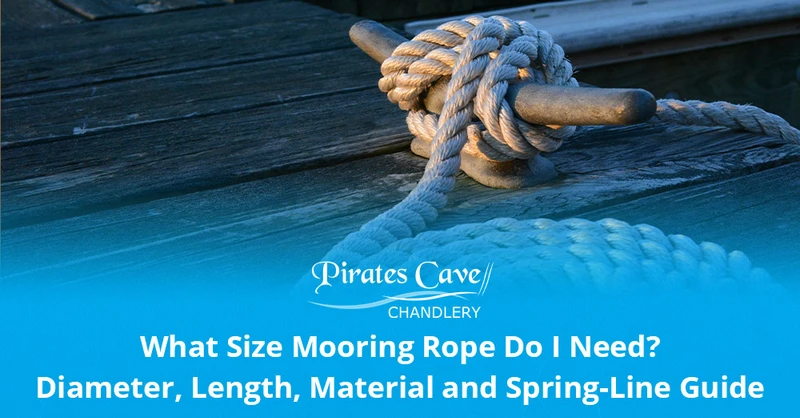
The correct mooring rope is selected by more than boat length. Displacement, windage, berth exposure, tidal range, line layout, rope construction, breaking load, cleat size and chafe all matter. As a practical starting point, many small and medium leisure boats use mooring lines in the 10mm to 20mm range, but a heavy, high-windage or exposed boat may need substantially larger or stronger lines than another boat of the same length.
This guide explains how to choose the diameter, length and material of bow lines, stern lines and springs without relying on one misleading rule. Pirates Cave stocks boat rope, mooring compensators and snubbers, fender ropes and wider anchoring and mooring equipment.
Do not choose by diameter alone: two ropes of the same diameter can have very different construction, breaking strength, stretch, handling and chafe resistance. Use the rope manufacturer’s load data and your boat or marina guidance as the final check.
Contents
- Key facts at a glance
- What determines mooring-rope size?
- Indicative diameter starting points
- Bow, stern, breast and spring lines
- How long should mooring lines be?
- Nylon vs polyester and other materials
- Adjusting for berth exposure and tide
- Stretch, snubbers and shock loads
- Chafe protection and deck fittings
- Inspection and replacement
- A practical buying checklist
- Frequently asked questions
- Technical references
Key facts at a glance
- Select mooring lines by displacement, windage, berth exposure and rope strength—not boat length alone.
- Diameter affects strength and handling, but construction and fibre determine how the rope behaves.
- Bow and stern lines control fore-and-aft position; springs are especially important for stopping surging along the berth.
- Permanent or exposed moorings usually need more stretch, chafe protection and reserve strength than a sheltered overnight berth.
- Nylon offers high elasticity and shock absorption; polyester offers good UV resistance, abrasion performance and predictable handling with less stretch.
- A line should fit the cleat, fairlead, chock and winch without jamming, overfilling or bending too sharply.
- Inspect the full working length, including hidden contact points, splices and the area that passes through fairleads.
- Keep spare lines long enough to rig an alternative lead when a berth or weather situation changes.
What determines the correct mooring-rope size?
Start with the boat’s displacement and windage. A deep, heavy cruising yacht and a light sports boat can have the same length but place very different loads on their lines. A tall motorboat, catamaran or boat with a cockpit enclosure may also generate greater wind loads than its length suggests.
Then assess the berth:
- Is it sheltered, or exposed to strong wind, wash or swell?
- Does the water level rise and fall substantially?
- Are lines led to a floating pontoon, fixed piles, wall rings or fore-and-aft moorings?
- Can a line run over a rough edge, rusty ring or concrete corner?
- Will the boat be checked daily, or left unattended for weeks?
- Can the cleats and fairleads safely accommodate the proposed diameter and load?
Finally, compare the rope’s published breaking load and recommended use. A thicker low-grade rope is not automatically safer than a smaller, purpose-designed mooring line. Account for knots, tight bends, ageing, UV exposure, contamination and abrasion, all of which can reduce effective strength.
Indicative mooring-rope diameter starting points
The table below is a selection starting point for conventional leisure craft using purpose-made mooring rope. It is not a safe-working-load certificate or a substitute for the rope manufacturer’s chart. Move upward where the boat is heavy for its length, has high windage, uses an exposed berth or will be left unattended.
| Approximate boat length | Typical displacement band | Indicative mooring-line diameter | When to move to the upper end or beyond |
|---|---|---|---|
| Up to 6m | Up to about 1 tonne | 10–12mm | Open berths, heavy RIBs or small motorboats, strong tide, rough fairleads |
| 6–8m | About 1–3 tonnes | 12–14mm | High cabin windage, exposed marina, long periods unattended |
| 8–10m | About 3–6 tonnes | 14–16mm | Heavy cruising yacht, motor cruiser, significant surge or wash |
| 10–12m | About 6–10 tonnes | 16–18mm | High-displacement or high-windage vessel, exposed tidal berth |
| 12–14m | About 10–15 tonnes | 18–22mm | Commercial-style loads, severe exposure, long fixed leads or large tidal movement |
| 14m and above | More than about 15 tonnes | 22mm and above | Engineering review is advisable; use actual loads, fitting strengths and rope-maker data |
The boat’s fittings can become the limiting factor. Do not fit an oversized line that cannot sit correctly on the cleat or pass through the fairlead. Equally, do not assume a small cleat can safely take the load merely because a thin high-strength rope will fit through it.
Strength must be balanced across the system: rope, splice, shackle, cleat, backing plate, fairlead, pontoon fitting and shore attachment all need suitable capacity. Upgrading only the rope can move the failure point somewhere less visible.
What do bow, stern, breast and spring lines do?
| Line | Typical lead | Primary job | Common mistake |
|---|---|---|---|
| Bow line | From the bow towards a point ahead or beside the boat | Restrains the bow and helps control fore-and-aft movement | Leading it too nearly at right angles to the boat so it cannot control surge |
| Stern line | From the stern towards a point behind or beside the boat | Restrains the stern and helps control fore-and-aft movement | Using a lead that fouls the propeller, outdrive, tender or bathing platform |
| Forward spring | From the bow or forward cleat aft along the berth | Prevents the boat moving forwards | Making it too short to absorb movement or tide |
| Aft spring | From the stern or aft cleat forwards along the berth | Prevents the boat moving backwards | Omitting it and expecting short bow/stern lines to stop all surge |
| Breast line | Approximately perpendicular from boat to berth | Holds the boat close to the quay or pontoon | Leaving it tight on a fixed quay where tidal rise can overload fittings |
Springs are often the most effective lines for controlling fore-and-aft movement because they can be led over a longer distance. Longer lines usually create a shallower load angle and allow more elastic movement than very short breast lines.
How long should mooring lines be?
There is no single length for every berth, but a useful onboard set normally includes:
- at least two lines approximately equal to the boat’s length
- at least two longer lines around one-and-a-half times the boat’s length for springs or alternative leads
- one or more spare lines long enough to reach a more distant bollard, pile or safe point
For a 10m boat, that could mean two lines of roughly 10m and two lines of roughly 15m as a general travelling set. A home berth may require custom lengths based on the actual cleat positions and tidal geometry.
Why not cut every line exactly to the berth?
Extra length gives flexibility when visiting another marina, doubling a line in bad weather, reaching a stronger shore point or re-leading around an obstruction. It also permits an end-for-end rotation so the same section is not always chafing. Excess line must still be coiled and secured so it cannot enter the water, propeller or walkway.
Fixed quay and tidal wall considerations
Long diagonal leads are important when water level changes against a fixed wall. Short breast lines can tighten dramatically as the boat rises or falls. Use the harbour’s recommended arrangement, allow for the full tidal range and avoid leaving a vessel unattended until the geometry has been observed through the relevant tide.
Which material is best for mooring rope?
| Material | Stretch and behaviour | Strengths for mooring | Limitations and cautions |
|---|---|---|---|
| Nylon / polyamide | High elasticity; absorbs shock well | Good for surge, wash and exposed permanent moorings when correctly sized | Can stiffen with age, heat internally under repeated cycling and suffer abrasion; some properties change when wet |
| Polyester | Lower stretch than nylon; stable and predictable | Good UV resistance, handling and abrasion performance; widely used for marina warps | May transmit greater peak loads than a more elastic line unless length or a snubber provides movement |
| Polypropylene | Light and usually floats; moderate stretch | Useful where a floating line is specifically required | Generally lower UV and abrasion durability than good nylon or polyester; can become harsh and degraded |
| HMPE / high-modulus fibres | Very low stretch and high strength for diameter | Useful in engineered specialist applications | Normally unsuitable as the only shock-absorbing mooring line; small diameter can be hard on hands and fittings |
| Mixed-fibre mooring constructions | Designed to combine handling, stretch and durability | Can provide a useful balance for purpose-made dock lines | Performance varies; use the manufacturer’s data rather than judging by appearance |
For many marina users, a purpose-made polyester mooring line is easy to handle and durable. For exposed berths with surge, a correctly sized nylon line or a system with suitable elastic compensation may reduce peak loads. The final choice should reflect the berth and deck layout rather than a generic preference.
How should the berth change your choice?
Sheltered floating pontoon
A floating pontoon rises and falls with the boat, reducing tidal geometry problems. Good-quality polyester or nylon lines with sensible springs are often suitable. Chafe still occurs at fairleads and pontoon rings, especially where wash makes the boat move continuously.
Exposed marina or harbour wall
Increase reserve strength and shock absorption. Use longer leads, effective springs, chafe protection and enough fenders. Inspect after strong winds because fibres may be damaged internally even when the line has not parted.
Piles, trot or fore-and-aft mooring
Loads and movement can differ greatly from a finger berth. The line may need to slide, be picked up from the water or pass through rings. Follow the mooring operator’s specification and consider professionally spliced eyes, thimbles or pickup arrangements designed for the installation.
Canal or river mooring
Current, level changes, passing traffic and bank condition matter. Avoid a line layout that can trap the boat beneath a fixed edge or allow it to swing into navigation. Local navigation-authority rules and mooring-owner instructions take priority.
Do you need mooring compensators or snubbers?
A mooring compensator or snubber adds controlled movement to a line and can reduce snatching, noise and peak loading. It is especially useful where the rope itself has limited stretch or the berth experiences repeated wash.
A snubber does not make an undersized or worn rope safe. Check:
- the compatible rope-diameter range
- the manufacturer’s fitting pattern
- whether the device can rub against the hull or pontoon
- whether enough movement remains before the line becomes bar-tight
- how the system behaves if the compensator fails
Rubber compensators, springs and elastic systems should be inspected along with the rope. Cracking, permanent deformation, corrosion or sharp edges are reasons to replace or service the component.
How do you prevent mooring-line chafe?
Chafe is one of the most common reasons a line fails. The highest-risk area is often not the visible middle of the rope but the short section moving through a fairlead, around a ring or over a rough edge.
- Run a cloth or gloved hand over fairleads and rings to locate burrs, corrosion and sharp edges.
- Use properly fitted chafe protection where the rope contacts a surface.
- Ensure the protective sleeve cannot slide away from the working area.
- Re-lead or rotate lines periodically so one spot does not carry every cycle.
- Avoid crossing lines where they can saw against each other.
- Keep lines clear of propellers, stern gear, exhausts and hot surfaces.
- Use spliced eyes or appropriate knots without creating tight bends that weaken the rope.
Oversized chafe tube can trap grit and seawater, so lift and inspect beneath it. A clean-looking sleeve can conceal a severely worn rope.
Cleats and backing structure
A mooring cleat must be through-bolted or otherwise attached according to the boat builder’s design, with adequate backing. Loose fasteners, cracked laminate, corrosion or distorted cleats require repair before relying on a stronger rope. Do not use guardrails, stanchions or other fittings as primary mooring points unless specifically designed for the load.
When should mooring ropes be replaced?
There is no universal calendar interval. Replace a line when damage, stiffness, contamination or loss of confidence makes its remaining strength uncertain.
| What you find | What it may indicate | Recommended response |
|---|---|---|
| Fuzzy surface over a broad area | Normal external abrasion may be developing | Monitor closely and compare with an unused section; replace if fibres are deeply worn |
| Flattened, glazed or melted fibres | Heat and severe cyclic loading | Replace; investigate snatching and line geometry |
| Cut fibres or a local notch | Contact with a sharp edge | Replace the affected line and remove the chafe source |
| Hard, stiff or kinked section | Ageing, contamination, internal damage or overload | Retire from primary mooring duty |
| Discoloured or chemically affected rope | Fuel, solvent, acid, alkali or unknown contamination | Check fibre compatibility and replace when uncertain |
| Damaged splice or pulled eye | Unequal load or splice deterioration | Have the splice assessed or replace the line |
| Line repeatedly becomes bar-tight | Insufficient length, stretch or poor lead | Redesign the arrangement rather than only fitting thicker rope |
Mark or label home-berth lines so their history is known. Keep visiting lines clean and dry where practical, and do not store wet rope in a sealed locker where mildew, odour and hidden corrosion of attached hardware can develop.
Mooring-rope buying checklist
- Record the boat’s length, displacement and high-windage features.
- Describe the berth: floating or fixed, sheltered or exposed, tidal range and expected wash.
- Measure the actual leads for bow, stern and spring lines.
- Check cleat, fairlead and ring dimensions.
- Choose a purpose-made rope construction and compare published breaking loads.
- Select enough elasticity through rope length, fibre choice or an approved compensator.
- Add chafe protection at every moving contact point.
- Carry at least one long spare line.
- Inspect the complete system after the first strong wind or full tidal cycle.
Build a complete mooring setup
Explore boat rope, mooring compensators and snubbers, and the wider mooring-equipment range. Protect the hull at the same time with correctly sized boat fenders.
When asking Pirates Cave for help, provide the boat length and displacement, berth type, tidal range, existing rope diameter, cleat dimensions and photographs of the line leads. That information is more useful than boat length alone.
Frequently asked questions about mooring ropes
What diameter mooring rope do I need for a 30ft boat?
A 30ft boat often falls near the 14–16mm starting range for conventional purpose-made mooring rope, but displacement, windage and exposure can move the answer higher. Check the rope manufacturer’s load table and ensure the proposed diameter fits the boat’s cleats and fairleads.
Is thicker mooring rope always better?
No. A line can be too large for a cleat or fairlead, difficult to handle and less elastic over the available length. Construction and breaking strength matter as much as diameter. The best line is strong enough, compatible with the fittings and able to absorb movement without becoming bar-tight.
How many mooring lines should a boat carry?
A basic travelling set normally includes at least four useful lines: two around the boat’s length and two longer lines suitable for springs, plus a spare where possible. The home berth may require more lines, breast lines or dedicated storm arrangements.
How long should spring lines be?
A useful general starting point is around one-and-a-half times the boat’s length, but the actual lead depends on the position of cleats and bollards. Springs should run far enough along the berth to control surge while retaining useful elasticity.
Is nylon or polyester better for mooring?
Nylon provides more stretch and shock absorption, which can be valuable in exposed locations. Polyester usually offers good UV resistance, abrasion performance and stable handling, making it popular for marina warps. The best choice depends on the berth and whether a snubber supplies additional elasticity.
Can I use climbing rope as a mooring line?
Use rope designed and rated for the intended marine application. Climbing ropes have different construction, ageing criteria, water behaviour and certification. Their history may also be unknown. A purpose-made mooring line is easier to assess and replace consistently.
What knot should I use on a mooring cleat?
A properly made cleat hitch is commonly used where the line does not have a spliced eye. It should be secure without excessive locking turns that jam under load. Crew should practise tying and releasing it, and the cleat must have enough space for the selected rope.
Are spliced-eye mooring lines better?
A well-made eye splice can provide a neat, strong termination and is convenient on a known cleat or bollard. A fixed eye can be less flexible at unfamiliar berths, so many boats carry a mixture of spliced and plain-ended lines.
Do mooring ropes need chafe guards?
Use chafe protection wherever a line moves over a fairlead, wall, ring or rough surface. The guard must stay in the working position and should be lifted regularly so grit and hidden wear beneath it can be inspected.
How often should mooring ropes be replaced?
Replace according to condition and duty rather than a fixed anniversary. A line used continuously in an exposed berth may deteriorate much faster than a lightly used visiting warp. Cuts, glazing, severe stiffness, damaged splices and uncertain chemical contamination justify replacement.
Should mooring lines be tight?
They should control the boat without becoming bar-tight as the vessel moves. Excessively tight lines transmit shock loads and can overload cleats or trap a boat at a fixed quay. Set springs and line angles so the vessel has controlled movement while remaining clear of hazards.
Can I use the same rope for anchoring and mooring?
Some fibres may be suitable for both applications, but the required construction, length, termination and load case differ. Anchor rope must work with chain, windlass or deck gear and needs suitable shock absorption and seabed abrasion resistance. Keep systems separately specified and identifiable.
Technical references
- LIROS: Purpose-made mooring-line product and application information
- LIROS: Rope recommendations and indicative sizing information
- Royal Yachting Association: Boat safety and maintenance guidance
Important: Diameter ranges in this guide are indicative selection starting points, not certified safe working loads. Follow the rope manufacturer, boat builder, marina or mooring operator. Exposed permanent moorings, large craft and unusual line geometry may require professional load assessment.