6th Aug 2026
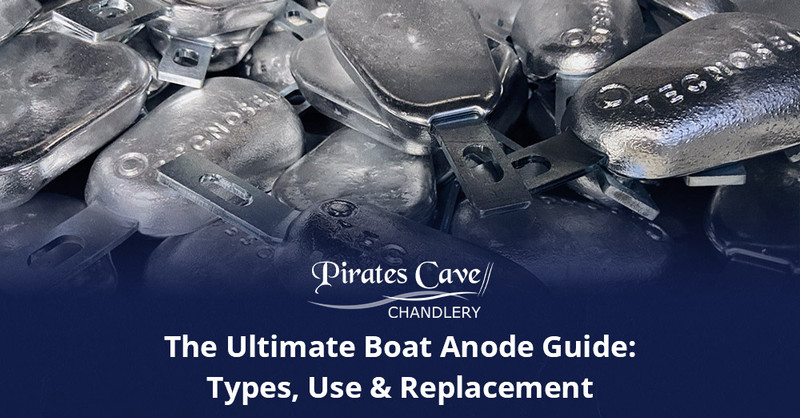
A boat anode is a deliberately reactive metal component that corrodes in preference to valuable underwater equipment. Correctly specified and installed marine anodes help protect propellers, shafts, drives, rudders, trim tabs, hull fittings and some internal cooling-system components from galvanic corrosion.
The difficult part is not understanding that an anode “sacrifices” itself. It is choosing the correct alloy, size and mounting arrangement for the equipment, water and vessel. This guide explains how boat anodes work, where to find them, how to inspect them and what unusual wear may be telling you.
The essential rule: identify the engine, drive or protected component first, then confirm the manufacturer’s part number, approved alloy and water application. Do not choose an anode solely because it looks similar.
Contents
- Key facts at a glance
- What is a boat anode?
- Galvanic corrosion vs stray-current corrosion
- Zinc vs aluminium vs magnesium anodes
- Choosing an anode by water type
- Common types and locations
- Identifying the correct replacement
- Inspection and replacement
- Correct installation
- Troubleshooting abnormal wear
- Can a boat have too many anodes?
- Bonding, shore power and galvanic isolators
- Guidance by hull material
- Frequently asked questions
Key facts at a glance
- Sacrificial anodes protect electrically connected underwater metals by corroding in their place.
- The common marine anode materials are purpose-made zinc, aluminium and magnesium alloys.
- Aluminium is widely used in salt and brackish water, while zinc remains specified for many saltwater applications.
- Magnesium is normally used in fresh water and should not be fitted in salt or brackish water unless the equipment manufacturer explicitly approves it.
- An anode must have a sound electrical connection to the component or bonding system it protects.
- Never paint, antifoul or coat the active anode surface.
- Many manufacturers advise replacement at approximately 50% loss, but the correct threshold and interval remain product-specific.
- An anode that does not wear may be incorrectly installed, electrically isolated, passivated or unsuitable for the water.
- Very rapid loss can indicate an electrical or bonding problem. A larger anode may mask the symptom without correcting the cause.
- Some important anodes are hidden inside engines, heat exchangers and raw-water systems.
Water type is an important part of anode selection, but it is not the only consideration. Manufacturers may specify different alloys for apparently similar equipment. The correct manual or approved parts list must therefore take priority over any general water-type table.
What is a boat anode and what does it protect?
A sacrificial anode is made from a metal alloy that is more electrochemically active than the underwater metal it is intended to protect. When the metals are electrically connected and immersed in conductive water, the anode supplies protective current and is gradually consumed.
Depending on the vessel and equipment design, anodes may protect:
- aluminium drive housings
- bronze or stainless-steel propellers
- stainless-steel shafts
- rudders and rudder stocks
- trim tabs
- metal skin fittings
- bow-thruster and waterjet components
- steel hull plating
- engine heat exchangers and raw-water passages
Anodes cannot prevent every type of corrosion. They are one element of a wider corrosion-control system that can include material selection, coatings, electrical isolation, bonding, correct wiring and, on some equipment, impressed-current protection.
A simple real-world analogy
Imagine a group walking through deep mud. One person deliberately wears inexpensive boots and takes the muddiest route so that everyone else can keep their better shoes clean. The sacrificial anode is the inexpensive pair of boots: it is intended to deteriorate so that more valuable equipment does not.
The analogy has limits. A real anode only protects a component when there is an effective electrical path between them and an ionic path through the surrounding water.
The technical explanation
A galvanic cell requires:
- metals or alloys at different electrochemical potentials
- an electrical connection between them
- a common electrolyte, such as seawater
- an anodic and a cathodic reaction
The more active metal becomes the anode and loses material through oxidation. The more noble metal becomes the cathode and is protected. A sacrificial anode deliberately makes this process occur on a replaceable component.
Water conductivity matters because it affects how readily protective current can flow. Salt water is generally more conductive than fresh water, while brackish water varies with salinity, temperature and local conditions. The surface area and type of the protected metals also affect the current required.
Galvanic corrosion, stray-current corrosion and general corrosion
These terms are often confused, but the distinction matters because they require different remedies.
| Type | Primary cause | Typical timescale | Can anodes help? |
|---|---|---|---|
| Galvanic corrosion | Electrically connected dissimilar metals in an electrolyte | Usually progressive | Yes, if the system is correctly designed |
| Stray-current corrosion | Unintended direct current entering or leaving a submerged metal | Potentially very rapid | Anodes may be consumed but do not repair the fault |
| General or localised corrosion | Environmental attack, coating failure, crevice conditions, material defects or other mechanisms | Variable | Sometimes, depending on the mechanism |
What causes galvanic corrosion?
Galvanic corrosion is a naturally occurring electrochemical process. No battery fault is required. Examples include an aluminium drive electrically connected to a stainless-steel propeller or a bronze fitting connected to other underwater metals.
The severity depends on the metals, their relative exposed areas, the water, coatings, temperature and electrical path. A small active-metal area connected to a much larger noble-metal area can be particularly vulnerable.
What is stray-current corrosion?
Stray-current corrosion is caused by unintended electrical current from a battery, charging circuit, DC equipment or another source. Current leaves a metal component, passes through the water and returns by an unintended route. Severe metal loss can occur at the point where current leaves the component.
It is sometimes called “electrolytic corrosion”, although stray-current corrosion is the clearer term.
Why a larger anode will not repair an electrical fault
A larger anode provides more sacrificial material and may last longer under otherwise normal conditions. It does not repair damaged insulation, reversed polarity, an incorrectly connected device or a DC conductor leaking into the water.
An unusually high consumption rate should therefore prompt investigation rather than the automatic fitting of more metal. Changes after a new electrical installation, shore-power connection or berth move are especially relevant.
Warning signs that require specialist investigation
Arrange a corrosion survey by a qualified marine electrician, engineer or corrosion specialist when you find:
- anodes disappearing within weeks or a small number of months
- rapid pitting of a drive, shaft, hull or propeller
- blistering paint and powdery corrosion around underwater metal
- one anode disappearing while connected anodes remain untouched
- a sudden change after new electrical equipment was installed
- tingling, shocks, damaged shore-power equipment or repeated electrical trips
- corrosion concentrated around a cable, fitting or underwater light
- repeated failures despite fitting the specified anodes
Safety warning: do not disconnect protective-earth conductors, modify bonding or perform live shore-power testing as an improvised diagnostic exercise.
Zinc vs aluminium vs magnesium boat anodes
The word “zinc” is still used informally for almost any sacrificial boat anode. In practice, anodes are available in several carefully controlled alloys.
| Material | Typical applications | Relative activity | Main strengths | Main limitations |
|---|---|---|---|---|
| Zinc alloy | Many traditional saltwater systems | Less active than magnesium | Established specifications and broad saltwater use | Can passivate in low-conductivity or brackish conditions |
| Marine aluminium alloy | Salt and brackish water; many modern drives and equipment systems | Usually more active than zinc | Performs across a useful salinity range and is widely specified by modern manufacturers | Must be a genuine anode alloy and is not automatically approved for every system |
| Magnesium alloy | Fresh water | Most active of the three | Provides useful driving voltage in low-conductivity fresh water | Can be consumed rapidly and may overprotect equipment in salt or brackish water |
Zinc anodes
Zinc anodes are the traditional saltwater material and remain correct wherever they are specified by the equipment or vessel designer. Zinc is used for hull, shaft, rudder, propeller and engine applications.
Zinc can become less effective in fresh water and some brackish environments because a surface film may reduce its activity. A zinc anode that remains almost unchanged should not automatically be treated as evidence that corrosion protection is working.
Marine aluminium-alloy anodes
A marine aluminium anode is not a piece of ordinary aluminium. It is a purpose-made alloy whose composition and electrochemical properties are controlled so that it remains active as a sacrificial material.
Aluminium anodes are now specified by several propulsion manufacturers for salt and brackish water. However, the correct conclusion is not that aluminium is universally better than zinc. The protected equipment, original cathodic-protection design, water and approved part remain decisive.
Some manufacturer-approved aluminium kits are rated for both fresh and salt water, while other manufacturers expressly recommend magnesium in fresh water. This difference reinforces the need to consult the manual for the exact engine or drive.
Magnesium anodes
Magnesium anodes are highly active and are normally selected for fresh water, where lower conductivity may make zinc or aluminium insufficiently active or prone to passivation.
Magnesium should not normally be fitted in salt or brackish water. It may be consumed extremely quickly, produce deposits and drive the protected structure to an excessively negative potential.
Magnesium also requires particular care on timber and aluminium vessels. Do not make a generic material change without specialist or manufacturer approval.
Which anode material should you use for each water type?
The following table is a starting point, not a substitute for the equipment manual.
| Water type | Usual starting choice | Important qualification |
|---|---|---|
| Salt water | Manufacturer-approved aluminium or zinc | Follow the exact drive, engine, propeller or vessel specification |
| Brackish water | Aluminium is commonly preferred | Salinity varies; zinc may passivate in some conditions |
| Fresh water | Magnesium is commonly specified | Some equipment has approved aluminium alternatives |
| Regularly changing water | Equipment-specific solution and closer inspection | A single alloy may not perform optimally in every environment |
Salt water
Salt water supports relatively easy current flow. Modern marine aluminium alloys and traditional zinc alloys can both be suitable, depending on the equipment.
Do not replace zinc with aluminium solely because aluminium is newer, lighter or described as more efficient. Confirm that every anode serving the same protected system is compatible with the change and that the manufacturer permits it.
Brackish water
Brackish water can be difficult because its salinity changes with tides, rain, river flow, locks and seasonal conditions. Aluminium is frequently the most practical general choice because it normally remains active across salt and brackish water.
Zinc may form a surface film and become ineffective in some lower-salinity conditions. Inspect closely after a berth move or major seasonal change.
Fresh water
Magnesium is normally the first choice for dedicated fresh water because it provides a higher driving voltage. Zinc and many aluminium anodes can become passivated and stop delivering useful protection.
There are exceptions. Certain manufacturer-designed aluminium kits are approved for fresh water as well as salt water. Use the equipment manual, approved parts list or authorised-dealer guidance rather than substituting a generic alloy.
Boats moving between water types
For short visits, the correct action depends on the equipment and duration. For extended moves, an anode change may be required. Record the date of the move and inspect sooner than usual.
A boat returning to sea with a passivated zinc or aluminium anode may not regain effective protection without cleaning or replacement.
Where are anodes located on a boat?
A boat may have one visible anode or dozens of external and internal anodes.
| Anode type | Typical location and function |
|---|---|
| Shaft anode | Clamped directly around the propeller shaft |
| Hull anode | Bolted or welded to a hull and connected to protected metals |
| Propeller anode | Mounted on or close to a propeller hub |
| Propeller-nut anode | Replaces or attaches to the shaft-retaining nut |
| Rudder anode | Mounted on a metal rudder or connected to its stock |
| Trim-tab anode | Fitted directly to each metal trim tab |
| Transom anode | Mounted near drives, tabs or other transom hardware |
| Outboard anode | Located on the bracket, gearcase, trim assembly and cooling passages |
| Sterndrive anode | Fitted to the drive, gimbal housing, trim cylinders or propeller hardware |
| Saildrive anode | Installed around or on the saildrive leg and propeller arrangement |
| Engine pencil anode | Screwed into a raw-water passage, cooler or heat exchanger |
| Bow-thruster anode | Located on the thruster leg, gearbox, propeller hub or tunnel equipment |
| Waterjet anode | Installed on waterjet housings, nozzles or steering components |
| Keel-cooler anode | Protects exposed cooler systems on commercial or work vessels |
External hull and propulsion anodes
Shaft, hull, propeller, rudder and trim-tab anodes are usually inspected at haul-out. Some can also be inspected by a diver or underwater camera.
A shaft anode must fit the shaft diameter correctly, close evenly and remain secure at operating speed. An anode that slips, spins or creates imbalance is not an acceptable installation. Owners of traditional saltwater shaft systems can browse zinc propeller-shaft anodes once the correct shaft diameter and manufacturer specification have been confirmed.
Outboard, sterndrive and saildrive anodes
Propulsion units may have multiple small anodes rather than one obvious block. Locations can include trim cylinders, anti-ventilation plates, propeller nuts, gearcases and transom brackets.
Anodes must remain immersed to protect a moored drive. A tilted drive with its anodes clear of the water may not receive the protection intended by its designer.
Hidden engine, heat-exchanger and cooling-system anodes
Raw-water-cooled engines, generators, intercoolers and heat exchangers may contain threaded pencil anodes or plugs that are invisible during a normal hull inspection. Check the engine and generator manuals, not just the outside of the hull.
A complete service or drive kit may include internal anodes that are easy to overlook. Where zinc remains the approved material, the zinc engine-anode range can help narrow the search by application.
Commercial and specialist applications
Steel workboats, waterjets, keel coolers, box coolers and commercial vessels can require a designed cathodic-protection system based on wetted area, coating condition, required life and operating environment. Generic leisure-boat rules are not sufficient for these systems.
How to identify the correct replacement anode
The safest identification process starts with the protected equipment, not with the appearance of the old anode.
Equipment and part-number checks
Record:
- boat make, model and year
- engine make, model, serial number and year
- drive, saildrive, gearbox or thruster model
- propeller make, model and material
- original or current anode part number
- approved anode alloy
- operating water type
- vessel construction material
- all equipment modifications
- whether the current anode is part of a matched kit
Original-equipment and compatible replacement anodes can both be suitable when their fit, alloy and electrochemical performance meet the application requirements. Avoid unverified castings whose alloy specification is unclear.
Measurement checklist
Before discarding the old anode, measure or photograph:
- maximum length, width and height
- shaft or bore diameter
- centre-to-centre bolt spacing
- mounting-hole diameter
- thread diameter and pitch
- recesses, tapers and locating features
- fixing-bolt length
- anode weight, where practical
- markings, casting numbers and labels
Place a ruler in the photograph and retain the old anode until the replacement has been checked against the equipment.
Individual anode or complete kit?
A complete kit can be the safer option for outboards, sterndrives and saildrives with several anodes. It reduces the risk of replacing only the obvious component while leaving smaller anodes depleted.
Confirm that the kit matches the exact drive generation and serial-number range. Similar-looking propulsion models may use different parts.
How often should boat anodes be inspected and replaced?
There is no universal annual interval. Wear depends on:
- water conductivity and temperature
- time afloat
- coating condition
- the amount of exposed underwater metal
- shore-power connection
- bonding and electrical condition
- marina infrastructure
- neighbouring vessels
- propulsion and accessory changes
- anode alloy, mass and installation
Approximately 50% consumption is a common practical replacement benchmark. It should not override a product-specific manual or a designed system with a different limit.
Why waiting until an anode disappears is risky
Protection depends on active surface area, electrical connection and remaining material. A nearly exhausted anode may be unable to deliver the required current, may become loose or may detach.
Replace it before the protected component becomes the most active metal in the system.
Suggested inspection schedule
The following is a conservative starting schedule. Adjust it after establishing the boat’s actual wear pattern.
| Vessel use | Suggested starting schedule |
|---|---|
| Frequently used and kept afloat | Visual check monthly where accessible; detailed inspection at least every two to three months |
| Permanently afloat | Regular in-water or diver inspection plus inspection at every lift |
| Seasonally used | Pre-launch, mid-season and at lift-out |
| Trailer boat | Inspect before launching, after cleaning and during scheduled engine service |
| Newly purchased boat | Inspect soon after purchase and again after a short period afloat |
| Boat in a new berth | Check more frequently until a stable wear rate is known |
| Boat with new electrical or stainless-steel equipment | Inspect shortly after installation and compare with the earlier wear record |
Keeping a wear record
Photograph every new anode before launch. Record:
- installation date
- part number and alloy
- starting dimensions or weight
- inspection dates
- percentage or measured material loss
- berth and water type
- electrical or propulsion changes
- unusual deposits or uneven wear
Where practical, weigh removed anodes. A written record makes a change in corrosion behaviour much easier to recognise.
How to install a boat anode correctly
An anode cannot protect anything if the intended electrical circuit is incomplete.
Preparing the mounting surface
For direct-mounted drive, shaft and equipment anodes:
- remove the old anode and approved fixings
- remove corrosion products, paint, scale and contamination from the contact area
- inspect threads, studs and mounting faces
- check the replacement against the old part
- install the specified fasteners and washers
- tighten to the manufacturer’s torque or fitting instructions
- check that the anode is secure and in direct electrical contact
Hull anodes mounted through GRP or timber use a different arrangement involving studs, backing material and an internal bonding connection. Follow the anode manufacturer’s full fitting instructions. Suitable anode backing pads and fixing bolts should be matched to the selected anode and hull arrangement.
Electrical continuity and fastening
Electrical contact must remain reliable after immersion and vibration. Loose fixings, painted mating faces, failed bonding conductors and insulated flexible couplings can prevent current reaching the protected component.
Continuity testing can help confirm the electrical path, but the results must be interpreted against the vessel design and equipment instructions. Ask a competent marine electrician or corrosion specialist when the system is unclear.
Paint, antifouling, grease and sealants
Never paint, antifoul or coat the active anode surface. It must remain exposed to the water.
Do not place grease or insulating compound between a directly mounted anode and its electrical contact face. Sealants, thread treatments and greases should only be used where the equipment or anode manufacturer permits them.
When applying antifouling paint, mask the anode carefully and maintain any manufacturer-specified clearance around it.
Safety considerations
Professional assistance is advisable where the work involves:
- lifting or supporting a vessel
- underwater diving
- shore-power or DC fault-finding
- hull-potential measurements
- drilling a hull
- welding anodes to steel or aluminium
- dismantling an engine, heat exchanger or drive
- checking torque or sealing on safety-critical equipment
Isolate machinery against accidental starting and follow the manufacturer’s service procedure.
Why is an anode wearing too quickly, not wearing or wearing unevenly?
Anode appearance is evidence, not a complete diagnosis. Several factors can produce similar symptoms.
Anode wearing too quickly
Possible causes include:
- stray direct current
- damaged DC wiring or insulation
- an onboard device leaking current
- shore-power and marina galvanic paths
- a fault on a neighbouring vessel
- incorrect bonding
- larger exposed metal area after coating damage
- a stainless-steel propeller or accessory added to an aluminium drive
- an anode alloy that is too active for the water
- a change of berth or salinity
- missing anodes elsewhere in the system
- failure of an impressed-current protection system
- additional equipment connected to the protected system
Do not assume that a neighbour is responsible without testing. A qualified corrosion survey normally includes visual inspection, continuity checks and potential measurements with an appropriate reference electrode.
Anode not wearing at all
Possible causes include:
- paint, oxide or sealant beneath the anode
- a loose or corroded electrical connection
- no continuity to the protected component
- passivation in unsuitable water
- the anode being above the waterline when moored
- an incorrect or poor-quality alloy
- a component isolated by a flexible coupling
- an anode installed on a part it cannot protect
- an active corrosion-protection system carrying most of the load
An apparently perfect anode is not necessarily good news. Check the protected metal for pitting and confirm continuity.
Uneven or unusual wear
Localised wear can result from:
- water flow and turbulence
- shielding by the hull or another fitting
- loose mounting
- unequal contact around a shaft collar
- different electrical paths through bolts or bonding conductors
- mixed anode materials
- the position of nearby metalwork
- an anode protecting more connected equipment than intended
Compare the wear with photographs of the original installation before deciding whether it is abnormal.
Can a boat have too many anodes?
Yes. Cathodic protection is an engineered balance, not a competition to fit the greatest possible mass.
Adding more anode material can move a protected structure to an excessively negative potential. Depending on the vessel and materials, overprotection may contribute to calcareous deposits, coating failure, hydrogen-related effects or alkaline conditions around protected fittings.
Timber vessels require particular caution because excessive cathodic activity can create highly alkaline conditions around fittings embedded in saturated timber. Aluminium hulls and drives should be protected to their designer’s specified potential range.
Do not add magnesium or supplementary anodes without approval from the vessel builder, equipment manufacturer, naval architect or corrosion specialist.
Bonding systems, shore power and galvanic isolators
What is a bonding system?
A cathodic bonding system electrically connects selected underwater metals to a common source of cathodic protection. It allows an anode to protect components that are not directly fitted with their own anode.
Not every metal object should automatically be bonded. The correct arrangement depends on vessel design, material compatibility, lightning protection, electrical grounding and the intended cathodic-protection scheme.
How shore power can create a galvanic path
When boats connect to shore power, their protective-earth conductors may create an electrical connection through marina infrastructure. This can join submerged metals on different vessels into a wider galvanic circuit.
The protective-earth conductor is an essential safety component. It must not simply be disconnected to reduce anode wear.
What does a galvanic isolator do?
A correctly specified galvanic isolator is installed in the shore-power protective-earth path. It is designed to block low-voltage galvanic current while preserving a safe path for higher-voltage fault current.
It is not a substitute for:
- correct AC and DC wiring
- residual-current and overcurrent protection
- anode maintenance
- bonding-system maintenance
- investigation of stray-current faults
Selection and installation should be carried out in accordance with applicable electrical standards and the device manufacturer’s instructions.
Galvanic isolator vs isolation transformer
An isolation transformer transfers AC power magnetically and removes direct electrical continuity between the shore supply and the vessel’s onboard AC system. A galvanic isolator retains the protective-earth path but blocks the small voltages associated with galvanic current within its design limits.
Neither device corrects an internal DC leakage fault. Marine electrical work should be designed, installed and tested by a competent person.
Anode guidance for different hull materials
GRP and fibreglass boats
A non-metallic hull does not remove the need for anodes. GRP boats commonly have metal propellers, shafts, drives, rudder stocks, trim tabs and skin fittings.
A hull-mounted anode on a GRP vessel normally protects electrically bonded equipment rather than the laminate itself. It requires the correct backing arrangement and clean, tight bonding connections.
Wooden boats
Timber boats may carry bronze fastenings, shafts, stern gear and other underwater metals, but cathodic protection requires careful design.
Anodes that are too active can create alkaline conditions around metal embedded in wet timber. Magnesium should not be fitted generically to a wooden hull. Seek specialist advice where hull fastenings or structural timber are involved.
Steel boats
A steel hull may use multiple welded or bolted anodes sized according to wetted area, coating condition, water and required protection period.
The coating remains the primary barrier. Anodes protect exposed areas and coating defects; they are not a substitute for maintaining the paint system. Owners of inland steel craft may also find our guide to narrowboat anodes useful.
Aluminium boats
Aluminium vessels are particularly sensitive to alloy compatibility, coating condition and protection potential. Use only systems approved by the builder or a competent cathodic-protection designer.
Do not fit magnesium, add large supplementary anodes or connect previously isolated fittings without professional advice. Where aluminium hull anodes are approved, confirm the dimensions and fixing arrangement before browsing aluminium hull anodes.
Boats with mixed underwater metals
Mixed-metal vessels need a coherent design. Factors include:
- which components are electrically connected
- the relative areas of each metal
- whether flexible couplings create isolation
- whether individual equipment has dedicated anodes
- whether the main hull anode is intended to protect the component
- whether manufacturer-approved kits use a specific alloy
Document any modification to propellers, trim tabs, thrusters, underwater lights or skin fittings and inspect the anodes after the change.
How to choose your next boat anode
Before ordering:
- identify the engine, drive and protected equipment
- find the manufacturer’s part number
- confirm the approved alloy for the water
- compare dimensions, threads and hole spacing
- check whether a complete kit is required
- retain photographs and measurements of the old anode
- inspect all related anodes, including hidden engine anodes
- investigate unusually rapid or absent wear before changing size or material
Find the correct replacement
Once you have identified the make, model, part number, dimensions and water type, browse the full boat-anode range, including aluminium, magnesium and zinc anodes.
When an old casting cannot be identified confidently or several similar kits appear to fit, contact the Pirates Cave team before ordering.
Key takeaways
- A boat anode is a replaceable part of a cathodic-protection system, not a universal cure for corrosion.
- Select the anode by equipment specification, approved alloy, water type and dimensions.
- Aluminium and zinc can both be correct in salt water; aluminium is commonly used in brackish water; magnesium is normally used in fresh water.
- Manufacturer guidance overrides general material tables.
- Never paint or antifoul an anode.
- Good electrical continuity is essential.
- Inspect new boats, new berths and modified electrical systems more frequently.
- Approximately 50% consumption is a common replacement benchmark, not an absolute rule for every product.
- An anode that disappears rapidly or does not wear at all warrants investigation.
- Do not modify a bonding or cathodic-protection system without understanding the original design.
- Remember internal engine, cooler and heat-exchanger anodes.
- Keep photographs, measurements, part numbers and inspection dates.
Frequently asked questions about boat anodes
What is a boat anode?
A boat anode is a replaceable metal component designed to corrode instead of more valuable underwater metalwork. It may protect a propeller, shaft, drive, rudder, trim tab, hull fitting or internal cooling component. Anodes form part of a cathodic-protection system and only work when the required electrical and water paths are present.
Why is it called a sacrificial anode?
It is called sacrificial because the anode is deliberately consumed during protection. The anode alloy is more electrochemically active than the metal being protected, so oxidation and material loss are directed towards the replaceable anode.
Which anode do I need for my boat?
Identify the engine, drive, shaft, propeller, thruster or other equipment first. Then check its manual or parts list for the approved part number and alloy. Confirm the boat’s water type, the anode’s measurements, hole spacing and thread. Do not select one solely from its shape or appearance.
What anode should I use in salt water?
Use the material specified for the exact equipment. Marine aluminium alloys are widely recommended for modern saltwater drives, while zinc remains correct for many traditional systems. Magnesium should not normally be used in salt water because it can be consumed rapidly and may overprotect the equipment.
What anode should I use in brackish water?
Aluminium is commonly preferred because it normally remains active across a useful range of salinities. Zinc can passivate in some brackish conditions. Brackish water varies considerably, so follow equipment guidance and inspect more frequently after changes in berth, rainfall or tidal conditions.
What anode should I use in fresh water?
Magnesium is commonly specified for fresh water because it remains highly active in relatively low-conductivity water. Some manufacturers approve particular aluminium anodes for fresh water, so check the exact manual before changing material.
Are aluminium anodes better than zinc?
Not universally. Purpose-made aluminium anode alloys can offer practical advantages and are widely specified for salt and brackish water. Zinc remains correct for many products and vessel systems. The better anode is the one approved for the protected equipment and operating environment.
How often should boat anodes be replaced?
Replace anodes according to measured wear and manufacturer guidance rather than using a fixed calendar interval. Approximately 50% material loss is a common replacement point. A boat in an electrically active marina may require more frequent replacement, while another may use the same anodes for longer.
Should boat anodes be replaced every year?
An annual change is convenient during seasonal haul-out, but it is not a universal engineering requirement. Some anodes will need replacing sooner and others may remain serviceable for longer. Inspect regularly and establish the actual wear rate for the boat and berth.
Can I paint or antifoul a boat anode?
No. Paint, antifouling and other coatings prevent the anode from contacting the water and can stop it working. Carefully mask the anode during painting. Follow the manufacturer’s instructions for coating the surrounding hull or drive.
Can a boat anode be cleaned?
Light surface film may be removable when the manufacturer permits it. Use the specified non-contaminating abrasive and avoid removing excessive anode material. Do not use a steel wire brush where it is prohibited. Replace an anode that is heavily wasted, cracked, loose or of uncertain condition.
Why is my anode disappearing quickly?
Possible causes include stray direct current, shore-power galvanic paths, damaged wiring, incorrect bonding, coating failure, unsuitable anode material or additional stainless-steel equipment. These are possible causes rather than a remote diagnosis. Very rapid loss should be investigated by a qualified specialist.
Why is my anode not wearing away?
The anode may have poor electrical contact, be painted, be out of the water, be passivated or use an unsuitable alloy. It may also be disconnected from the component it is meant to protect. Check the protected metal as well as the anode.
Can a boat have too many anodes?
Yes. Excessive cathodic protection can create deposits and damage certain coatings or materials. Timber and aluminium vessels require particular care. The number and mass of anodes should be based on the original vessel design or a competent cathodic-protection assessment.
Do fibreglass boats need anodes?
Usually, yes. The GRP hull itself does not corrode like metal, but the boat may have metal propellers, shafts, drives, rudders, trim tabs and skin fittings. These components can require individual or bonded cathodic protection.
Do stainless-steel propellers need anodes?
The surrounding propulsion system may require additional protection when a stainless-steel propeller is installed, particularly where the drive housing is aluminium. Use the propulsion manufacturer’s specified anodes and have the system checked after changing propeller material.
Do outboard motors need anodes?
Yes. Outboards normally contain several external and sometimes internal anodes. Their locations vary by model and can include the bracket, trim system, gearcase and cooling passages. Consult the owner’s manual and replace the complete specified set where appropriate.
Do anodes protect against stray-current corrosion?
Anodes may reduce damage temporarily or be consumed by the extra current, but they do not correct a stray-current fault. Damaged wiring, insulation failures and leaking DC circuits must be located and repaired.
Can shore power affect anode wear?
Yes. The shore-power protective-earth connection can create a galvanic path between boats and marina structures. A correctly installed galvanic isolator or isolation transformer can address the shore connection within its design scope, but neither replaces safe wiring, proper bonding or fault investigation.
Why do anodes wear differently on neighbouring boats?
The boats may have different metals, coatings, anode alloys, immersed areas, wiring, bonding systems and shore-power arrangements. Their drives may also be positioned differently in the water. Proximity alone does not mean that two boats should have the same wear rate.
Technical references
The following manufacturer and technical sources provide further equipment-specific or standards-based information:
- Volvo Penta: Marine engine anodes
- MG Duff: Choosing the correct anode material
- MG Duff: Cathodic protection and corrosion
- ISO 9351:2025: Galvanic anodes for cathodic protection
- ABYC: Cathodic bonding
- Victron Energy: Isolation-transformer principles
Important: This guide provides general maintenance information. Always follow the instructions for the specific vessel, engine, drive, propeller, thruster or other equipment. Lifting, diving, shore-power testing, electrical fault-finding, hull modification and internal engine work may require qualified assistance.